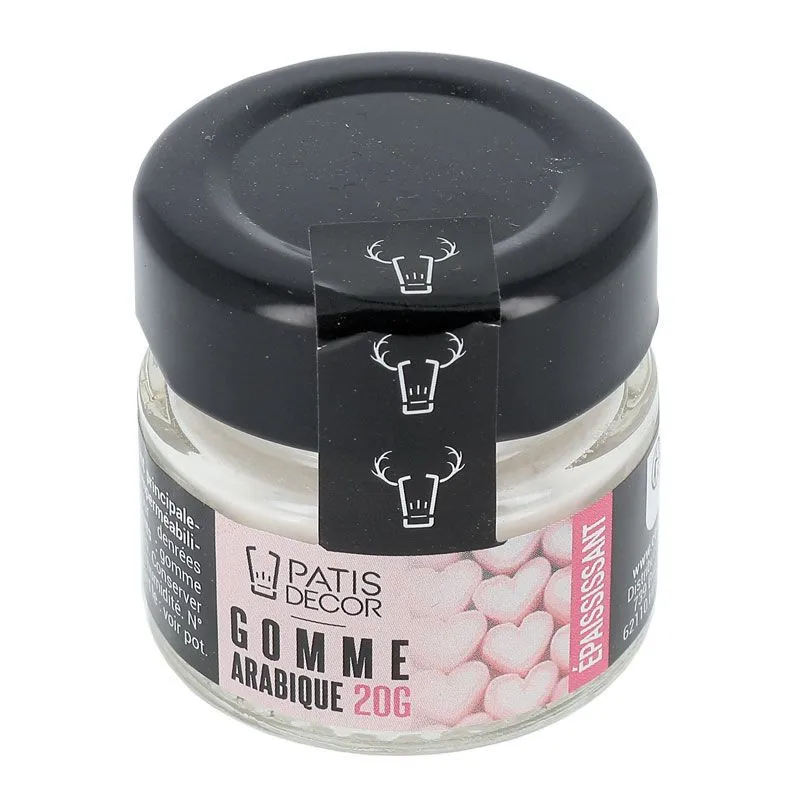
Gum Arabic 20g
What is gum arabic – and where does it come from?
Gum arabic is a natural plant sap obtained from the trunks and branches of acacia trees – mainly in the Sahel region of Africa. After harvesting, the sap is dried and processed into a fine powder. The result is a whitish to slightly yellowish powder that is odourless and flavour-neutral, and dissolves easily in water. Gum arabic is one of the oldest food additives in the world – it is entirely natural in origin, vegan, and gluten-free. In the kitchen and patisserie, gum arabic serves several purposes at once: it thickens liquids, binds ingredients together, seals surfaces, and enhances flavours. Unlike many synthetic additives, it neither changes the taste nor the smell of the preparation – it works invisibly in the background, ensuring that the end result achieves the desired texture, the right sheen, and the necessary stability.
How to use gum arabic
Gum arabic can be used in two ways depending on the application. The simplest method: stir the powder directly into the mixture – for example into a dough, an ice cream base, or a confectionery blend. If gum arabic is to be used as an icing or coating – for example for Gingerbread, dragées, or sweets – it is best to dissolve the powder in warm water first and then brush it on or roll the confectionery in it. The right amount depends on the application. For ice cream and dairy products, very small quantities of 0.4–0.7% of the total weight are sufficient – for 1 kg of ice cream base this is around 4–7 g of powder. For beverages, as little as 0.02% is enough. For doughs and biscuits, the dosage is 0.008–0.02%. For the classic gum Syrup – the Gingerbread icing – simply dissolve 20 g of powder in 1 litre of sugar water. For coating sweets and dragées, use a more concentrated solution of 30–50%.
What is gum arabic suitable for – and what does it actually do?
If you make your own marshmallows, you need gum arabic. It is the reason marshmallows have their characteristic chewy, elastic texture and don't fall apart when cut. Without gum arabic, these airy confections would lose their shape. Anyone making dragées or sweets knows the challenge: the surface must be smooth, glossy, and moisture-resistant. Gum arabic solves exactly that – dissolved in warm water and applied to the surface, it seals dragées and sweets, protects them from moisture, and gives them their characteristic, even sheen. In home-made ice cream, gum arabic prevents the formation of ice crystals. The result is a creamy, fine texture that stays stable during freezing and doesn't turn hard or crumbly when served. In beverages, gum arabic holds the ingredients together – it prevents liquids from separating, stabilises foams, and improves mouthfeel. For Gingerbread, Biber, and confectionery, gum arabic is the classic glazing agent. Anyone who has ever glazed a Gingerbread without gum Syrup knows the difference: without gum arabic, the surface stays dull and flat. With gum arabic, the Gingerbread gets the clear, silky sheen that makes it a real eye-catcher. Recipe: dissolve 20 g of gum arabic in 1 litre of sugar water and brush it onto the still-warm Gingerbread – done. The gum arabic simultaneously seals the surface and protects it from drying out.
Storage
Gum arabic is sensitive to moisture and must therefore be stored correctly. The powder draws moisture from its surroundings and clumps together – which impairs quality and makes dissolving more difficult. Always seal the storage container tightly and keep the powder in a dry, cool, and dark place at 15–25°C. Do not store near steam, water, or humidity – so not directly next to the hob or in a damp kitchen. Stored in a tightly sealed original packaging, gum arabic keeps for a long time and is ready to use at any time.
The natural thickener for confectionery
Gum arabic is one of the oldest and most versatile food aids in the world – natural in origin, odourless and flavour-neutral, and virtually indispensable in confectionery and patisserie. It gives marshmallows their texture, lends dragées and sweets their sheen, makes ice cream creamy, and gives Gingerbread the unmistakable, silky gloss you know from the confectioner's. Once you understand what this little powder does, you won't want to be without it. A natural helper that works in the background – and makes all the difference in the final result.