
Ready-to-ship quantity: more than 20 pieces20+ in stock
Price:CHF24.80
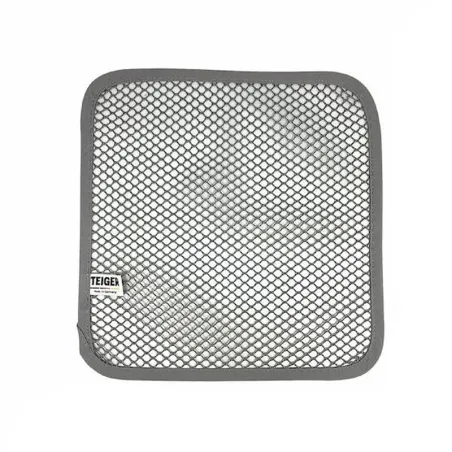
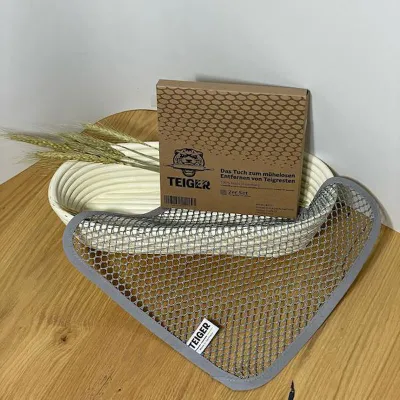
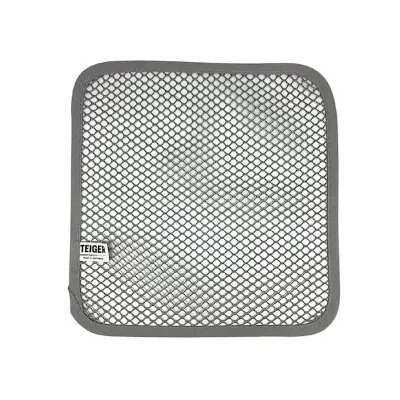
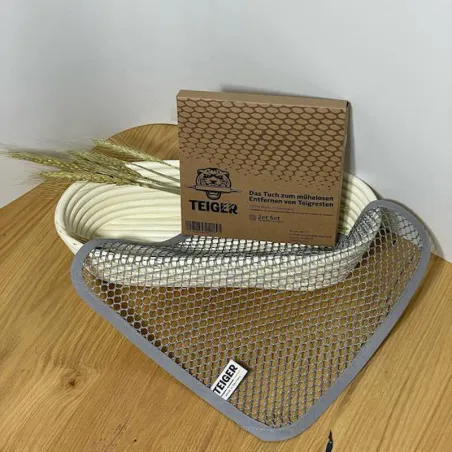
Anyone who bakes regularly knows the problem: dough residue sticks to bowls, dough hooks, work surfaces and hands. A normal sponge spreads the dough more than it removes it. Kitchen paper disintegrates. A cloth absorbs the dough, then sticks itself and smells unpleasant within a few days. This is not a quality problem of individual products – it is a material problem. Dough is sticky, contains fat, becomes more viscous with warmth and dries to a mass that defies normal cleaning products. What is missing is a cloth developed specifically for this purpose. Torsten Volz and Heiko Karl from Sinzheim in Baden-Württemberg have developed it: the Teiger. A cleaning cloth with a fine mesh structure, hand-sewn and reinforced hem, made from non-toxic, Oeko-Tex 100-certified materials, produced in Germany. Fresh and dried dough residue, sticky masses and stubborn deposits – the Teiger removes them from bowls, dough hooks, baking moulds, work surfaces, glass-ceramic hobs and hands, without scratching, without sticking itself, without accumulating bacteria. The Teiger cleaning cloth is available at miniSchoggi.
Torsten Volz and Heiko Karl are not kitchen accessories manufacturers in the classical sense. They are two entrepreneurs who identified a concrete problem and developed a concrete solution. The problem: dough residue is difficult to remove with conventional cleaning products. This is not a question of insufficient care when cleaning, but a question of physics. Dough consists of flour, water and fat – a combination that adheres to surfaces, spreads under pressure rather than releasing, and dries to a mass that resists normal sponges and cloths. Sponges become sticky. Kitchen paper dissolves. Cloths absorb the dough, become sticky themselves and create an ideal environment for bacteria.
The solution was not a new cleaning agent but a new material with a new structure. The fine mesh structure of the Teiger works on a simple mechanical principle: the mesh surface grips the dough residue, pulls it away from the surface and holds it in the mesh structure until rinsed out, without sticking to it itself. That is the difference between a sponge, which is soft and porous and tends to absorb dough residue rather than remove it, and a cloth that actively cleans through its structure.
All Teiger materials come from Germany. The hem is hand-sewn and additionally reinforced – a production step that costs more time than machine sewing but considerably improves the cloth's durability. Anyone who has ever discarded a cheap cleaning cloth after a few weeks because the seams had come apart understands why this matters. A reinforced hand-sewn hem is not a luxury detail but a quality feature that pays off in longevity.
All materials used comply with the Oeko-Tex Standard 100 – the globally recognised testing mark for textiles that ensures the product is free of harmful substances. For a cloth used in direct contact with food contact surfaces, baking utensils and hands, this is not an optional certification but a given. The material is completely non-toxic – the Teiger can be used without concern on all surfaces that come into contact with food.
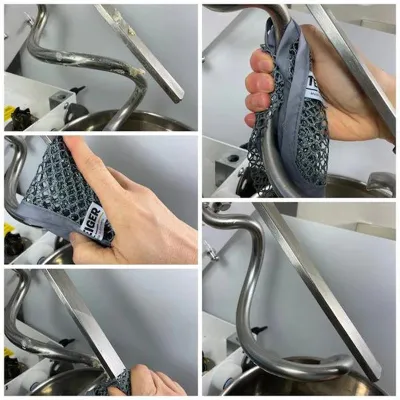
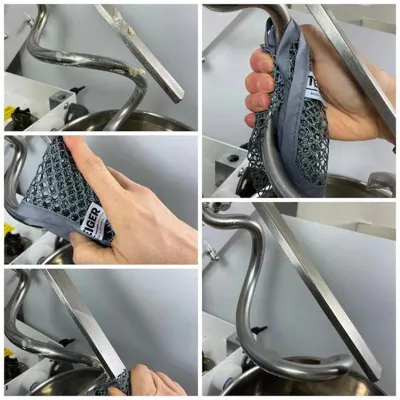
Fresh dough residue from bowls, work surfaces or hands: the Teiger removes them in one wiping motion. Dried dough residue that has already hardened: the mesh structure releases these too, without scratching and without the need to scrub. Sticky masses on dough hooks or spiral kneaders: the flexibility of the cloth allows cleaning even at irregular shapes and tight spots that could not be reached with a rigid sponge. Surfaces made of plastic, chrome, stainless steel, silicone, non-stick coating, glass, porcelain or ceramic: the Teiger scratches none of them.
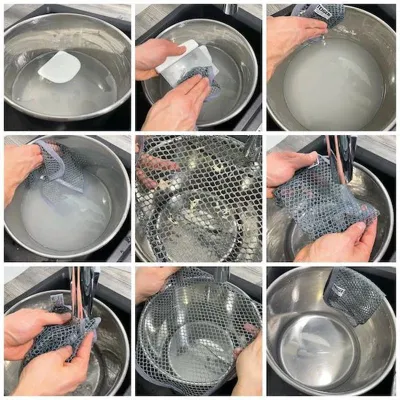
After use, simply rinse under running water – the Teiger is immediately clean again because dough residue is rinsed out of the mesh structure rather than becoming stuck in it. For a more thorough clean it can be folded and placed in the dishwasher. The fine mesh structure prevents bacteria from taking hold – that is why the Teiger does not develop the unpleasant odour familiar from normal kitchen cleaning cloths. If after drying individual crumbs remain in the mesh structure, these fall out by themselves.
A cleaning cloth is not an exciting purchase. But a cleaning cloth that solves a problem you encounter with every baking session is one of the most useful things you can introduce to a bakery. Anyone who has stood after bread baking in front of a bowl with dried dough, a sticky dough hook and a floury work surface and knows how much water, time and energy the scrubbing costs – understands what the Teiger solves. Not through chemistry, not through more force, not through more water, but through the right material with the right structure.
That is a simple idea, consistently implemented: developed by two entrepreneurs who knew the problem themselves and recognised that no existing product genuinely solved it. Produced in Germany from Oeko-Tex 100-certified materials, with a hand-sewn hem that holds – not for one season but for years. The fact that the cloth does not smell after use, does not stick, and can be cleaned in thirty seconds under the tap is not a side detail. It is the difference between a tool you replace after a few weeks and one you keep. miniSchoggi carries the Teiger because good tools in the bakery do not stop at cutters and baking moulds. The Teiger cleaning cloth is available at miniSchoggi.
Sinzheim, Baden-Württemberg. One problem. Two entrepreneurs. One mesh structure. Teiger.