
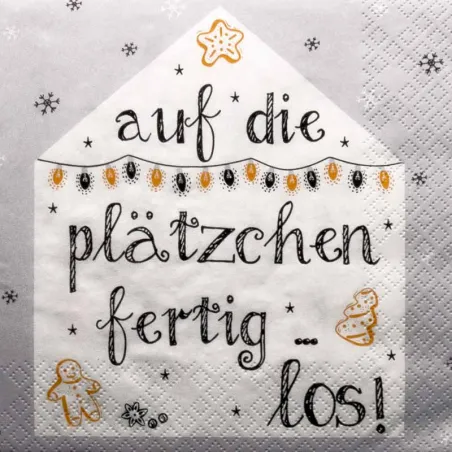
Ready-to-ship quantity: more than 20 pieces20+ in stock
Price:CHF3.90
What began in 1870 as a cardboard factory in a Saxon village is today one of Europe's best-selling designer napkin brands. Streckewalde, Erzgebirge – not a place one would intuitively associate with worldwide presence on laid tables. And yet: those who know Home Fashion know this place, even if they have never read the name. Carl Dietrich GmbH has been producing napkins and table products there since 1990, and since 1996 under the Home Fashion brand, which has since become the company's core. What sets these napkins apart from what fills most supermarket shelves can be read in three layers. In the material: FSC-certified, oxygen-bleached cellulose from the EU, no synthetic fibres, water-based printing inks without volatile organic compounds. In the printing process: 8-colour flexographic printing, introduced as the first company in the industry in Germany, enabling colour depth, motif complexity and reproducibility on flexible tissue material simply unachievable with fewer colours. And in the energy: a large part of the factory's electricity comes from in-house water turbines. The Nordic Eco Label that Carl Dietrich GmbH received in 2020 is external confirmation of this overall approach. At miniSchoggi, selected Home Fashion napkins are available.






Not many companies founded in the 19th century still exist. Even fewer have transformed their product range so fundamentally that almost no trace of the original activity remains – and have remained recognisable as a brand nonetheless. Carl Dietrich GmbH has done both. Starting in 1870 as a manufacturer of white-ground winding board in Streckewalde – a district of Grossrückerswalde in the Saxon Erzgebirge district –, the company survived two world wars, the GDR and the associated state management. In 1990, immediately after reunification, it passes to new private owners. The decision they make is radically clear: away from industrial cardboard, towards napkins and table products. The location in Grossrückerswalde stays. What is produced there does not.
The company needs six years after this realignment before the business becomes a brand. In 1996, Home Fashion appears – and with it a design promise: napkins not as consumables but as decorative elements. That this positioning works has technical foundations. At this point, Carl Dietrich GmbH is the first company in the industry in Germany to invest in 8-colour flexographic printing – a printing technique that on flexible materials like tissue enables colour depth, outline sharpness and motif complexity simply unachievable with four or six colours. The brand's design ambition was technically underpinned from the outset.
In 2009, the «Unique» collection appears, and with it a technique that had not existed in the industry until then: full-surface embossing on paper napkins. Not printed patterns, but mechanically pressed structures – three-dimensional, visible and tangible. The embossing fundamentally changes not only the appearance but also the tactile feel of the product: an embossed napkin sits differently in the hand, has a different weight and a different texture from a printed one. Carl Dietrich GmbH developed and introduced this technique themselves. The Unique napkins are sold in display packaging with a «Touch-it» opening, so the purchasing decision is based on tactile experience rather than the view through a plastic film.
A further change of ownership follows in 2017. The new management deliberately avoids diversification and concentrates investment on core competences: printing, embossing, finishing of napkins and table products. Design trends are actively monitored and translated into new collections – not in annual batch releases, but continuously. In 2018, a die-cutting system is added. Since then, napkins can not only be printed and embossed but also shaped: silhouettes, irregular contours, floral cutouts, motif outlines. The shape of the napkin itself becomes a design decision.
Paper napkins are single-use products. That is uncomfortable, but it is reality. The more honest question is therefore not whether one should avoid them, but how they are manufactured. Home Fashion has answered this question in production terms – not with communication measures, but with decisions built into factory operations.
The tissue material comes exclusively from the EU and is FSC-certified – the internationally recognised Forest Stewardship Council system that certifies timber harvesting and forestry against ecological, social and economic standards. All product lines are manufactured from 100% oxygen-bleached cellulose. Oxygen bleaching differs from conventional chlorine bleaching in one essential respect: it produces no chlorinated organic compounds as a by-product – substances that enter waterways and can accumulate in ecosystems. Synthetic fibres are not used; the material is entirely plant-based cellulose.
The printing inks are water-based. Solvent-based inks contain volatile organic compounds – VOCs – released into the surrounding air during printing and drying, loading both indoor and outdoor air. Water-based systems largely avoid this. Health-damaging bleaching agents and questionable auxiliary substances in finishing are avoided entirely.
The energy question is perhaps the most compelling element: a large part of the factory's electricity is generated by in-house water turbines and consumed directly at the production site – no external compensation, no purchased certificate, but site-based infrastructure that draws production energy regeneratively from the surroundings. The Nordic Eco Label that Carl Dietrich GmbH receives in January 2020 is the external result of this totality. The Scandinavian environmental certification system – originally introduced in 1989 by the Nordic Council of Ministers – is considered one of the most stringent of its kind, setting requirements for raw material origin, chemical composition, production processes, energy use and disposability.
The Home Fashion range encompasses over 500 different motifs, renewed seasonally, thematically and in design terms annually. Printed tissue napkins in 8-colour flexographic printing form the core range: three layers, oxygen-bleached FSC cellulose, motifs from florally classic to contemporary-geometric. The Unique collection offers full-surface embossing – a napkin expressing itself through structure rather than motif, in display packaging with Touch-it opening. Die-cut napkins go beyond the rectangle and bring the shape itself into play. The Eco Line consists of two-layer, recycled FSC-certified paper – for all those who want to rely explicitly on recycled material without sacrificing motif quality.
Printed tissue napkins · Embossed Unique napkins · Die-cut shaped napkins · Eco Line from recycled paper
A birthday table, a wedding banquet, an Advent coffee: there is always a napkin. And almost always it is the last thing thought about – which is a pity, because it is the first thing guests touch. A napkin that suits the table, the occasion, the mood is not a luxury. It is a small decision with visible effect.
Home Fashion provides the basis for this: a range developed for over 30 years exclusively for this one purpose, with a technical depth – 8-colour printing, proprietary embossing technique, die-cutting system, FSC-certified material, Nordic Eco Label – one would not necessarily expect of a disposable product. Placing a Home Fashion napkin on the table means placing more than paper: a design element that shows someone thought about the table setting. miniSchoggi carries Home Fashion because this thinking matches what miniSchoggi customers do: bake, decorate, celebrate – and pay attention to details others do not see but guests feel. The range at miniSchoggi includes selected Home Fashion napkins for various occasions and is continuously expanded.
Since 1870. From the Erzgebirge. For tables that deserve more than going through the motions. Home Fashion.