
Ready-to-ship quantity: 55 in stock
Price:CHF60.00

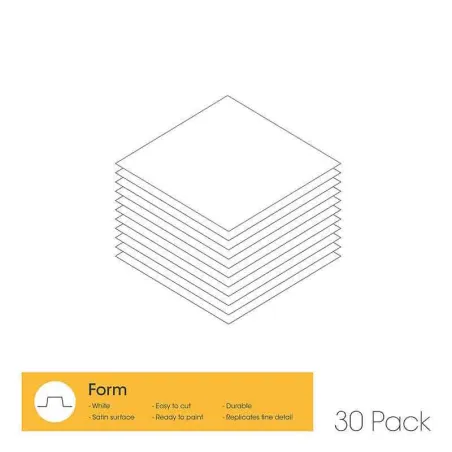
Ordering a personalised chocolate mould is a project. Weeks pass between first enquiry and first prototype. Small quantities barely make economic sense, minimum order quantities are high, corrections cost more time and money. Anyone who simply wants to make their own praline presentation, a company logo in chocolate or a one-off cake decoration usually fails not because of skill – but because of the access barrier. The mould is the problem, not the chocolate. That is exactly what Mayku has changed. The FormBox – a compact vacuum former developed from 2015 by London designers Ben Redford and Alex Smilansky – turns an industrial production process into a desktop process. A food-safe sheet is heated, drawn over a model, sucked down by one's own vacuum cleaner and sets in seconds into a finished mould. The model can be a 3D print, a wood carving, a shaped piece of clay – or anything else that is heat-resistant and dimensionally stable enough. The FormBox captures details down to the size of a grain of sand. The result is immediately ready for use, costs a fraction of an industrial mould and can be repeated as many times as desired. In 2016 the Kickstarter campaign raised over a thousand times its original target. Today thousands use the FormBox in over 70 countries – including renowned chocolatier Paul A. Young, Nike and NASA. miniSchoggi carries the food-safe sheets for the Mayku FormBox.
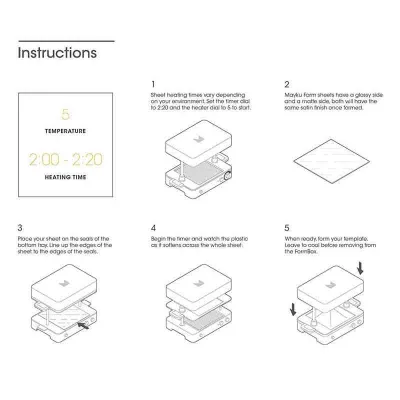
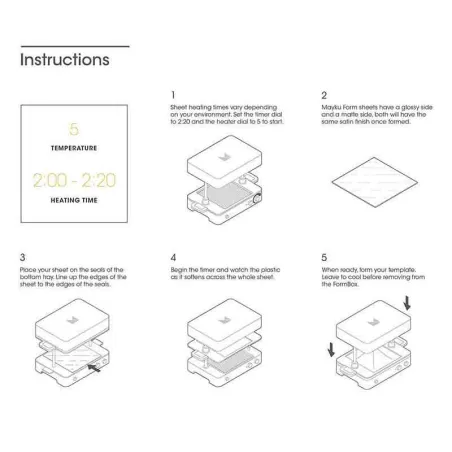
Vacuum forming is not a new invention. Industrial operations have used the process since the 1960s: a plastic sheet is heated to softening temperature, stretched over a positive form and drawn by vacuum against its contours. Once cooled, the sheet holds the exact geometry of the original – as a negative mould that can be filled any number of times. The process is standard in packaging, product design and medical technology. Robust, reproducible, precise.
What it could not do: stand on a desk or kitchen counter. Industrial vacuum forming machines are large, expensive, loud and structurally unsuited to micro-quantities. Anyone needing a single personalised chocolate mould had to either commission expensive contract manufacturing, order a silicone mould with minimum quantities and long delivery times – or go without. The technology existed. Access for individuals, small confectioneries and creative businesses did not. Ben Redford identified the problem during a trip to production facilities in China, where he observed how even simple product ideas were structurally inaccessible for individuals – not for lack of technology, but because of the cost thresholds, minimum orders and lead times of industry. The vision was clear: a factory that fits on a desk.
Ben Redford's final project at Goldsmiths College, University of London, already incorporated vacuum components and small manufacturing processes. After graduating, he worked – as did his future co-founder Alex Smilansky – at the product development studio Mint Digital in London, where digital products were developed for clients including Tesco and the British Home Office. The two met there, shared an interest in physical product development and the desire to make manufacturing more accessible.
Redford took the first step with the Design Council Spark Fund, which provided him seed capital for development. At Makerversity in London – a founder centre for product designers at Somerset House – he initially received three months of free hot-desking to develop the concept further. Alex Smilansky left Mint Digital and became co-founder. Together they founded Mayku Industries in 2015, developed five iterations of the device and prepared the Kickstarter campaign. In 2016 the campaign launched. The goal was modest: 100 pre-orders. What followed was one of the most successful crowdfunding launches in British product design history: 1,745 backers, $588,000 in 30 days. In 2018 the first FormBoxes were shipped. Today thousands in over 70 countries use the device – including Nike for prototyping and NASA for special applications.
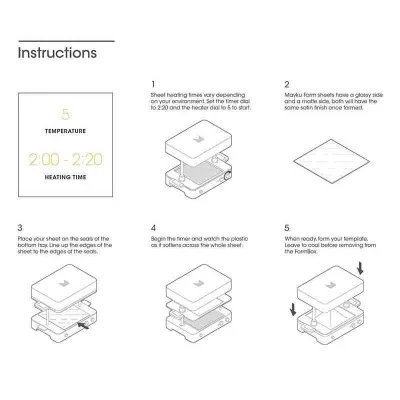
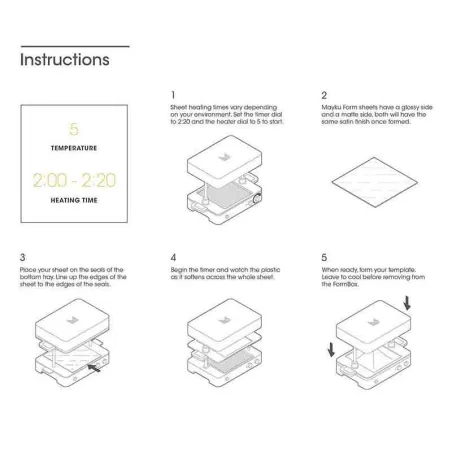
The operating principle of the FormBox relies on proven physics and radically simplified handling. The device heats a plastic sheet to its specific softening temperature – the point at which the thermoplastic material becomes soft and mouldable but has not yet begun to flow. In this state the sheet is lowered over the model; the connected household vacuum cleaner – no industrial device, no special accessory – generates the vacuum that draws the soft sheet seamlessly against every contour. Within seconds the sheet cools and sets in the assumed geometry. The mould is ready.
What works as a model is deliberately left open: 3D-printed objects, laser-cut parts, hand-modelled clay or wood forms, everyday objects. The FormBox captures surface details down to the sub-millimetre range – textures, lettering, fine grooves are fully transferred into the mould. For chocolate processing two technical details are decisive: first, wall geometry – a draft angle of 5 to 10 degrees enables clean release of the chocolate without applying pressure. Second, corner design: slightly rounded corners are easier to fill and demould than sharp internal corners. These principles apply to every chocolate mould, whether polycarbonate, silicone or vacuum-formed sheet.
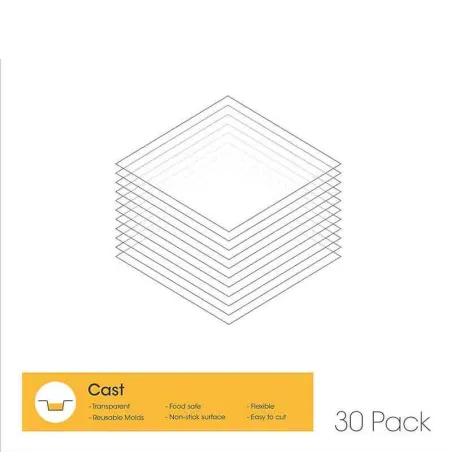
The sheet is the decisive link between device and result. For use with chocolate, food-safe sheets in thicknesses of 0.5 mm and 1 mm are recommended. The 1 mm sheet gives the finished mould more stability and is particularly suited for moulds with pronounced depth or complex geometry. The 0.5 mm sheet is more flexible, which eases demoulding, and gives more precise results for flatter motifs – tablets, relief plates, decorative bases.
Both sheet thicknesses are tested as food-safe, heat-resistant to tempered chocolate temperatures and can be filled directly with couverture – without release agents, without pre-treatment. The handling corresponds exactly to that of a polycarbonate or silicone mould: temper the couverture, fill, allow to set, demould. The only difference: no dishwasher. The sheet is cleaned by hand and is directly reusable. The quality of the mould surface – and thus the high gloss of the tempered couverture – depends directly on the surface quality of the model: smoothly polished gives shiny, rough gives matt. This is not a limitation but a design opportunity.
Paul A. Young, one of Britain's most renowned chocolatiers, uses the FormBox professionally at his operation in London. What has convinced him and many other confectioners is not the technology itself – making chocolate moulds is not a new concept. It is the speed and directness of the process: a new mould designed today can go into production tomorrow. No email exchange with a mould manufacturer, no delivery time, no minimum quantity discussion.
This enables things that were previously either impossible or prohibitively expensive: a seasonal collection with a custom pattern that runs for just four weeks. A wedding cake with a personalised monogram in chocolate, made the day before. A company logo for a client, cast in white couverture, ready the next morning. Things that until a few years ago either were not accessible at all or cost hundreds of francs per piece. Applications go far beyond chocolate: soap casting, plaster and concrete moulds for decorative pieces, wax candles, resin casting, packaging prototypes.
Sheets for Mayku FormBox · 0.5 mm & 1 mm thickness · Food-safe · Reusable
Those who want to make their own chocolate moulds have long had two options: buy a ready-made mould that already exists – or order a custom mould and wait weeks. The FormBox adds a third option that simply did not exist until a few years ago: make it yourself, immediately, with your own design, in your own bakery. This is not a plaything for technology enthusiasts. Paul A. Young, Nike and NASA use the same basic principle for professional and industrial applications.
The FormBox has proven itself in practice – not because it is technically spectacular, but because it solves a real problem: access to personalised mould making, without the costs, waiting times and minimum quantities of industry. The food-safe sheet is the consumable that enables this process – precise, reproducible, immediately ready for use. miniSchoggi carries the sheets for the Mayku FormBox because the tool belongs in every bakery that wants more than the standard range from a catalogue.
2015. London. A factory that fits on a desk. Mayku.