
Basel, 1925. Adolf Hollinger rides his motorcycle from bakery to bakery. In his bags: fruit essences and non-toxic colours – products he has developed himself, which do not yet exist in this quality and focus on the market. Bakeries, confectioneries and restaurants become his customers. The colours can be worked into creams, doughs and decorations; the flavourings give vanilla cream and fruit tarts the taste that home-made preparations can barely achieve without concentrates. What begins as a one-man operation on two wheels grows over decades into a recognised Swiss manufacturer of food colourings and baking flavourings – with a loyal customer base that does not change brands because there is no reason to. In 2019, William Hollinger, son of the founder, closes the independent production operation. The brand, the recipes and even the large colour mill pass to Günter Aroma AG in Beinwil am See – a Swiss family business founded in 1997 as a flavour manufacturer, today producing the brands Hollinger, Plusaroma and Sodadrops. The quality of the colours and flavourings remains the same. The recipes that Adolf and William Hollinger refined over decades have not disappeared – they are being continued. At miniSchoggi, Hollinger products are available
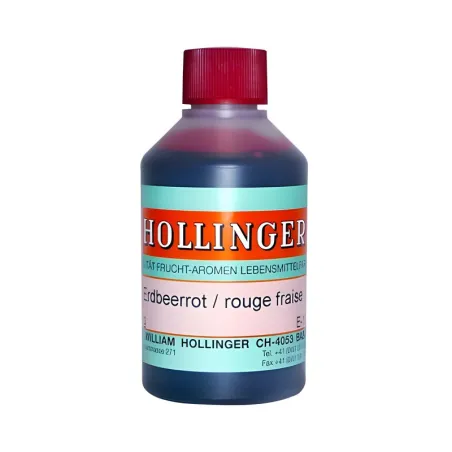
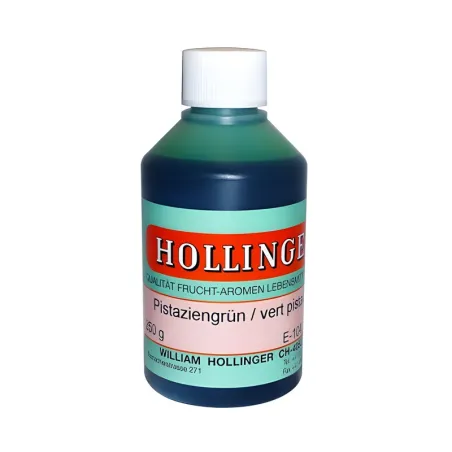
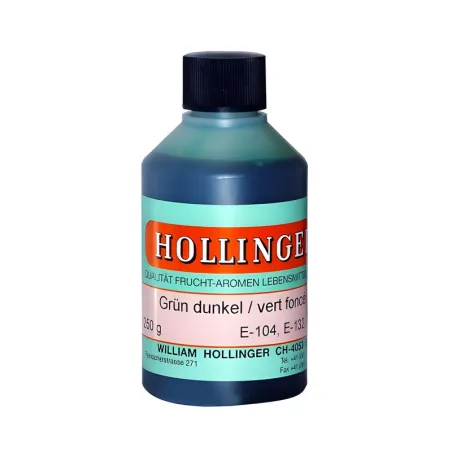
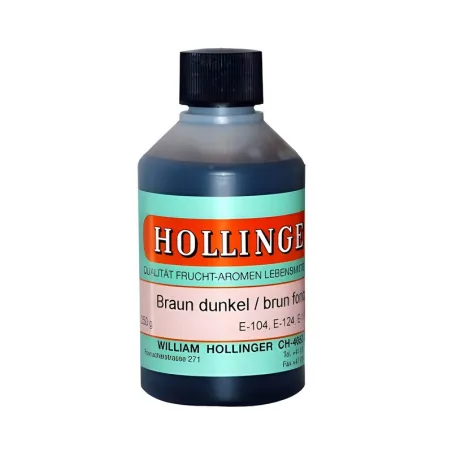
The man who began the story of Hollinger had no office, no sales representative and no marketing budget. Adolf Hollinger had a motorcycle and a product he believed in. From 1925, he rode through Basel and the surrounding area, knocked on the back doors of bakeries and confectioneries and presented his fruit essences and non-toxic food colourings. The term 'non-toxic' was not self-evident at the time – it was a promise. Synthetic dyes of the era were not always tested for safety, and the fact that Hollinger's colours were explicitly developed for use in edible products was a concrete competitive advantage.
What Hollinger gained through his visits was more than a customer base: he acquired a deep understanding of the baking craft. He knew which flavourings worked in which quantities for which applications. He understood the seasonal requirements of confectioneries. He knew when a bakery wanted to try a new flavour and when it needed reliable quantities of proven standards. This knowledge fed directly back into product development. Hollinger did not develop in the laboratory what he then tried to offer the market – he developed what the market needed, because he knew the market personally.
For some years, Hollinger attempted to extend this foundation into enamel products – bowls, moulds, work surfaces, household items. The factory outside the residential area produced everyday items. But plastic and stainless steel displaced enamel from the mass market. Hollinger recognised the signs in time and returned to what had made him successful – the flavourings and colours whose quality and reputation in the industry remained undiminished.
In the daily operation of a large bakery or confectionery, flavourings and colours are consumed in quantities that are difficult to imagine as a private individual. Vanilla in an industrial bakery does not mean a small bottle – it means litres, dozens of them during peak season. Accumulated across an entire industry and an entire season, several tonnes could be what Hollinger delivered in a single month. The range covered industry standards – vanilla, strawberry, raspberry – and went beyond: seasonal flavourings such as panettone or cinnamon, in demand only in certain months, were carried alongside bespoke special orders for individual customers seeking a distinctive flavour profile for their products.
The logistics of the time were robust and circular: flavourings were filled into large glass bottles, delivered to bakeries, and when empty, the bottles came back and were refilled – a system reflecting the close, personal connection between manufacturer and customer. Today, different quantities are needed. Home bakers, cake designers, people who want to bake at professional level at home are now an important part of the customer base. The glass bottles have given way to practical plastic bottles. What matters has remained.
When William Hollinger took over the management, the production and distribution of liquid food dyes were systematically expanded and professionalised. The colours were developed and mixed in the same office where Adolf had worked. A large colour mill ground and combined the ingredients with precision. This step is technically decisive: the fineness of the pigment particles directly influences how evenly a colour distributes in a mass, how intense the colour tone turns out and how stable it remains under heat and light. A poorly ground colour produces uneven tones, streaks and colour loss during baking. Hollinger colours do not do this – and that is the result of a manufacturing process designed for precision.
Liquid food colourings differ fundamentally from paste or powder colours in their application properties. They dissolve quickly, can be well dosed and are particularly suited to masses with an already high moisture content – mirror glaze, royal icing, water-based glazes. For airbrushing they are ideal: the liquid consistency enables even atomisation through the airbrush gun without clogging nozzles or producing uneven application. Using liquid colours with fondant, marzipan or buttercream is not recommended however – the moisture of the liquid colour alters the consistency of these masses in a way that impairs workability. For these applications, paste colours or powder colours are the better choice.
In 2019, William Hollinger closes the independent production operation. It is not a decision against the brand – it is a decision for its continuation under new conditions. The recipes, the brand rights and parts of the production equipment – including the characteristic colour mill – are transferred to Günter Aroma AG in Beinwil am See. Transferring the colour mill means that the way of producing is continued: recipe and process remain together. Günter Aroma AG is at this point already an established Swiss family business, founded in 1997 as a flavour manufacturer, with steadily expanded expertise in the development and production of food flavourings, dyes and specialist ingredients.
In 2021 the company moves into a newly built main building at Reinacherstrasse 21 in Beinwil am See. The packaged flavourings and dyes – including the Hollinger line – are produced in building 19, industrial productions in the new building. Today Günter Aroma AG produces among others the brands Hollinger, Plusaroma and Sodadrops. What the acquisition means for Hollinger: a secured production base, modern infrastructure and the know-how of a company working daily in the world of food colourings and flavourings – combined with recipes that have stood the test in the Swiss professional baking industry for almost a century.
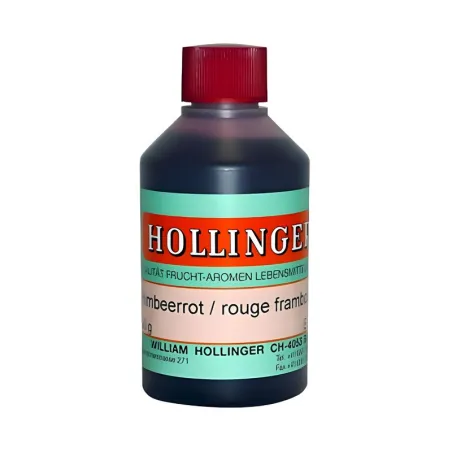
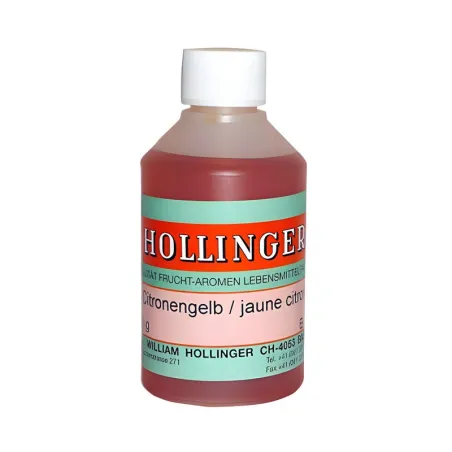
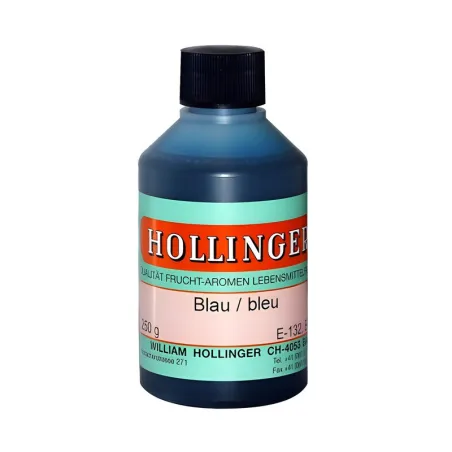
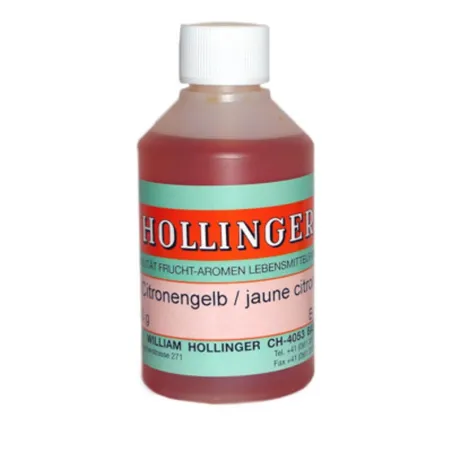
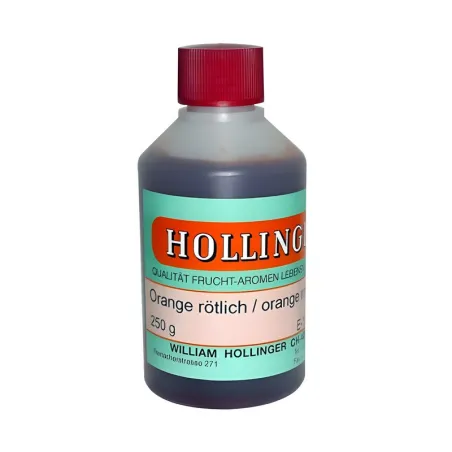
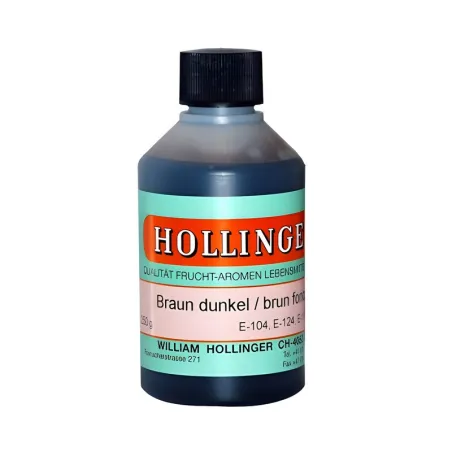
Hollinger food colourings come in two forms: as liquid colours and as water-soluble colour powders. Liquid colours in a broad colour spectrum – blue, strawberry red, pistachio green, dark green, raspberry red, pure yellow and many more – enable precise dosing and quick integration into liquid or semi-liquid masses. Particularly proven for mirror glaze, royal icing and airbrush applications. Water-soluble colour powders enable more intense colour tones where little additional moisture should be introduced into the mass. Flavourings in classic and seasonal variants – vanilla, strawberry, raspberry, panettone, cinnamon and more – complement the range for baked goods, ice creams, creams and drinks.
Liquid food colourings · Water-soluble colour powders · Baking flavourings
Colour in cake decoration is not a stylistic element among many – it is often the first thing noticed and the last thing forgotten. A vivid red mirror glaze, a strong cobalt blue in an airbrush motif, a rich dark green on a fondant disc: this only works when the colour itself delivers what it promises. Not pale in tone. Not uneven in distribution. Not unstable under heat or light. Hollinger colours do this. Not because it is a marketing statement, but because the recipes have been developed for professional use since 1925 and used daily in Swiss bakeries. A brand that survives almost a hundred years in professional use does not do so by chance.
miniSchoggi carries Hollinger food colourings because they are made for customers who know what they want – a strong, even colour tone that can be precisely dosed, flows smoothly in airbrush operation and remains stable in the finished product. Whether for airbrushing on fondant, for mirror glaze or for royal icing: Hollinger is the choice when compromise is not an option. For applications such as fondant, marzipan or buttercream, where paste or powder colours are better suited, miniSchoggi carries complementary products – because good advice belongs to the brand.
Since 1925. From Basel, today in Beinwil am See. Hollinger – food colourings for everyone who takes colour seriously.