
Ready-to-ship quantity: more than 20 pieces20+ in stock
Price:CHF6.50

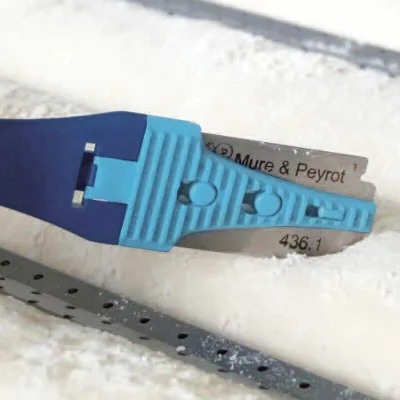
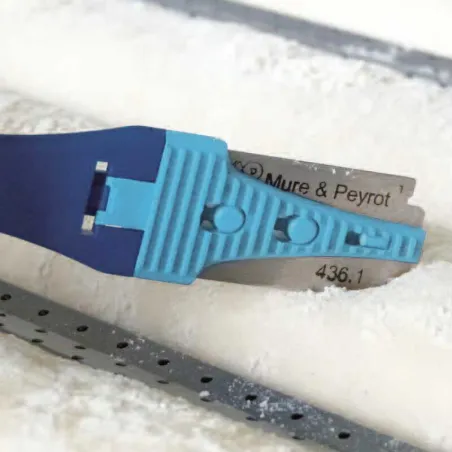
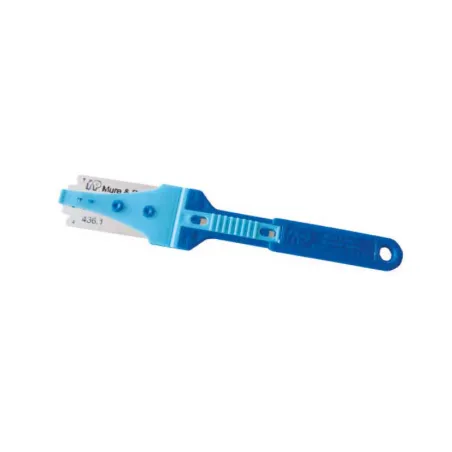
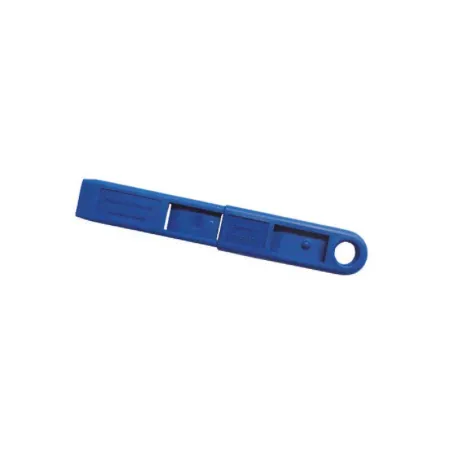
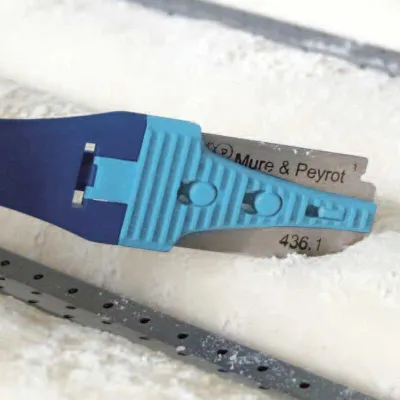
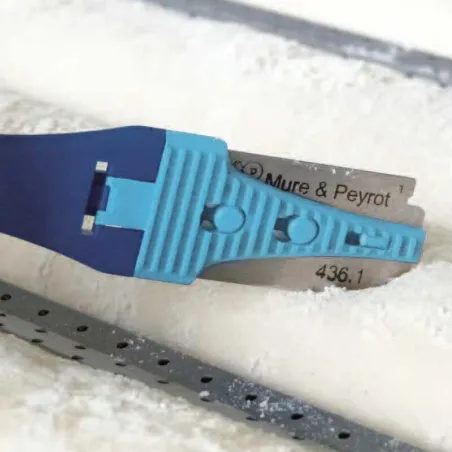
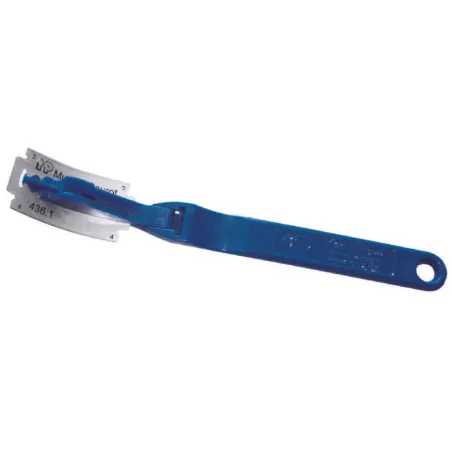
A cut. Deep enough to give the dough room. Shallow enough not to destroy the loaf. Sharp enough to open without pressure. Anyone who has experienced a blunt knife pulling a perfectly proved dough together instead of opening it knows: the tool decides. Not the dough. Not the proving time. The knife. Mure & Peyrot makes knives. Since 1904, in Thiers – the cutlery capital of France, known since the Middle Ages for blades ground along the Durolle. Today leading in France for industrial knives. The baker's lame came in 2005 – late in the company calendar, but with the same engineering principle as every other product: a safety locking mechanism so the blade does not slip during scoring. Replaceable razor blades, because a sharp replacement is better than a blunt original. EU certification for food contact. No compromise. Mure & Peyrot baker's lames are available at miniSchoggi.
Thiers lies in the Puy-de-Dôme, Auvergne. Anyone who walks alongside the Durolle there understands why blades have been ground here since the 13th century: the gradient of the river provided the water power for grinding wheels long before electricity took over this work. Around this river, over centuries, a collective craft system emerged – blacksmith for the blank, grinder for the edge, polisher for the surface, handle-maker for the finish. No one did everything alone. All together they made a knife. Thiers today produces 80 per cent of all knives made in France. The name of the town is its programme.
Claude Mure bought a cutlery forge in the middle of this tradition in 1904. Not as an invention, but as an entry into something that had existed in the region for generations. His son Edouard continued the business alone after the death of his brother Antoine in the First World War. What he produced followed no master plan but the needs of his time: grafting knives for agriculture, one-handed knives for war veterans who had lost an arm, linoleum cutters for the floor covering that emerged in the post-war period. Every product a tool for a specific problem.
Ernest Peyrot joined the company in 1938, became managing director in 1954, gave the company its second name. Jean-Claude Peyrot and his wife took over later. The headquarters moved to Bordeaux. What did not change: the conviction that a knife must above all be one thing – safe to handle.
Most knife accidents do not happen during cutting but before and after. From the 1990s Mure & Peyrot developed safety knives for industrial applications – first for deburring windscreens (Gironde, 1994), then for warehouses, parcel centres, airports. Multiple innovation awards. Market leader in France. Second-largest manufacturer of safety knives in Europe. This principle – safety locking, protected blade transport, simple controlled change – is the same one that flowed into the baker's lame in 2005.
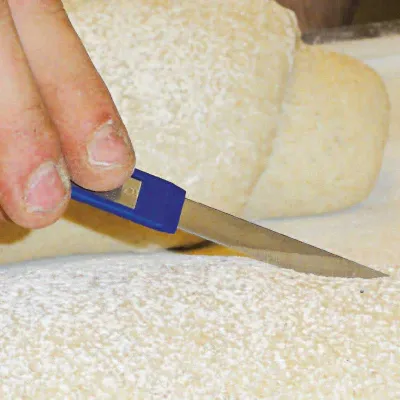
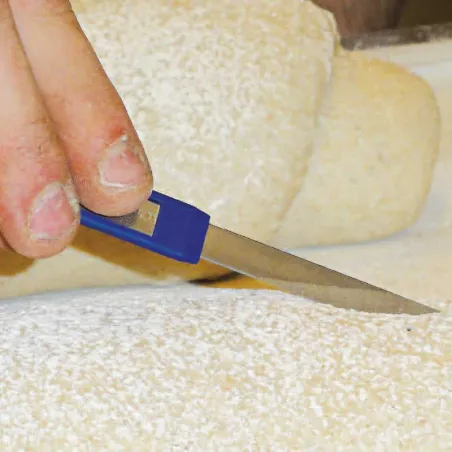
Scoring bread dough shortly before baking is not a decorative act. It is a technical intervention in the structure of a living dough. The cut opens defined escape routes for the forming CO₂ – controlled rather than random. Without scoring, the dough tears where the gluten is weakest. With a clean cut, the ear forms: the split, crispy edge that makes a bread a craft bread.
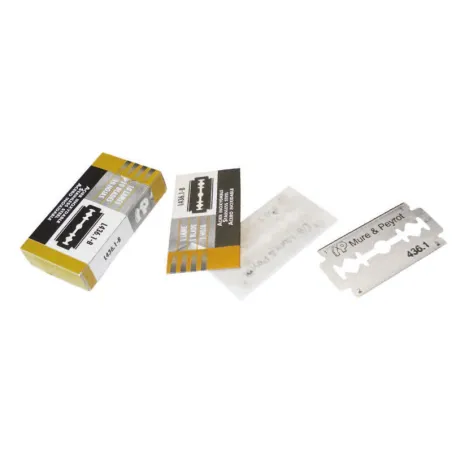
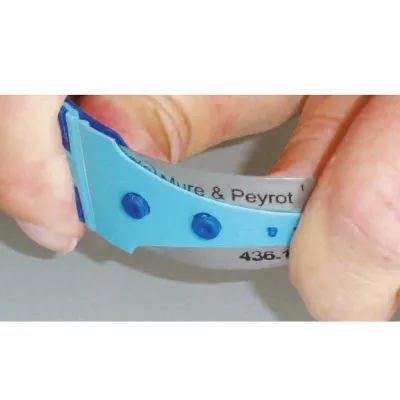
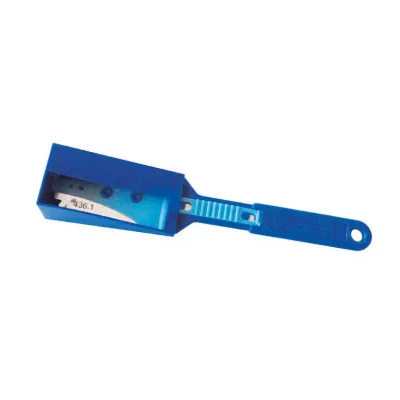
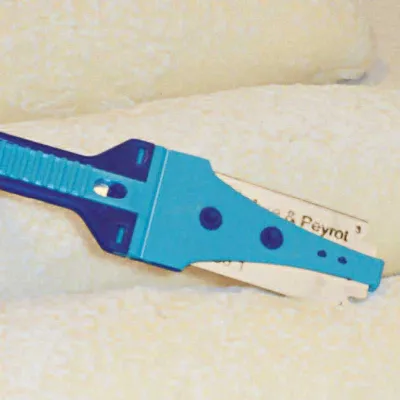
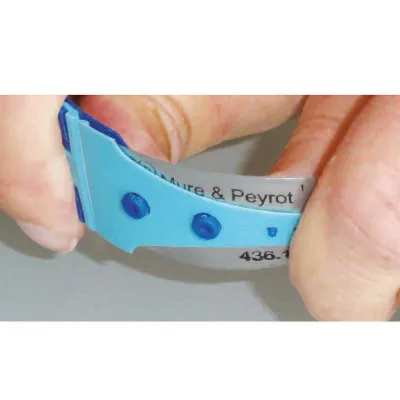
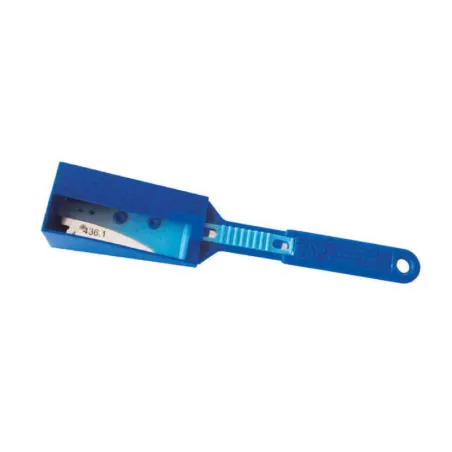
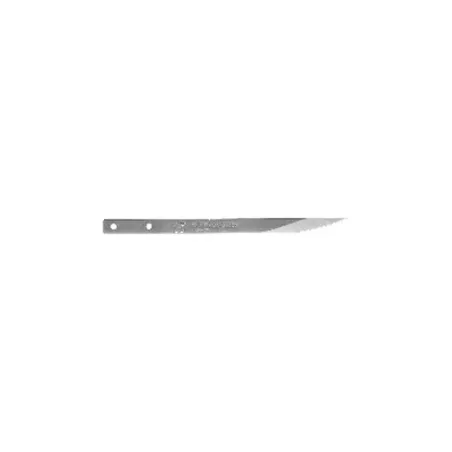
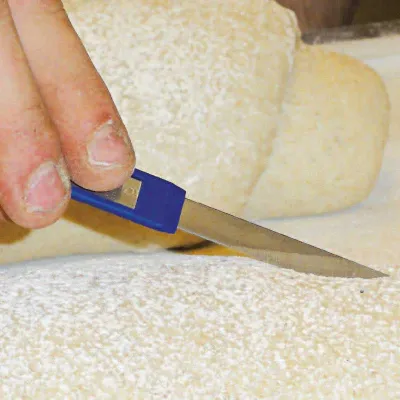
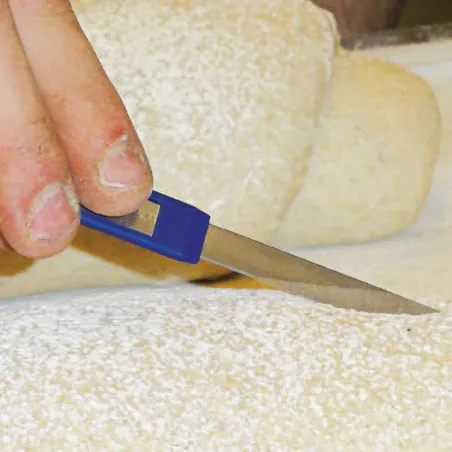
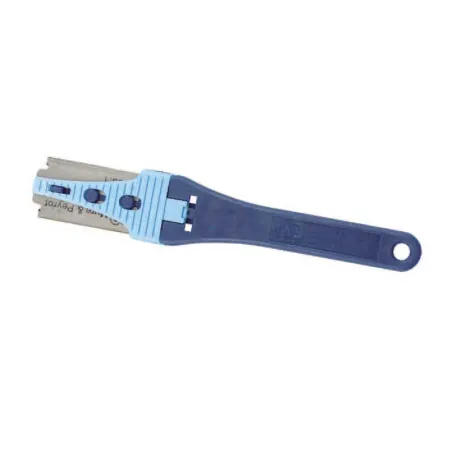
For this to succeed, the blade must be sharp enough to open the dough without pressure. Mure & Peyrot uses standard razor blades in stainless steel – not as a cost decision, but because razor blades are precisely ground and immediately sharp. Four blade edges, all usable. Blade change in seconds, without tools. Straight blade or curved blade – the choice depends on the scoring pattern. Straight for deep longitudinal or cross cuts, diamond patterns, floral designs. Curved for shallow surface cuts where the blade is guided at an angle and ears or pouches form – the typical baguette pattern.
Baker's lame with straight blade · Baker's lame with curved blade · Replacement blades
A baker's lame is not a decorating tool. It is a technical intervention in the structure of a proved dough that decides how a bread rises – and how it looks. A proved loaf is under tension: the gluten network has tightened, CO₂ bubbles are trapped, the surface is under pressure. The score gives the dough a defined weak point through which it can rise in a controlled way. What emerges through this opening is the ear: the split, crispy edge that distinguishes good bread from ordinary bread. No score means uncontrolled tearing – where the gluten is weakest, not where one intended. The score also determines the pattern – diamonds, spirals, ears of wheat. Not as decoration, but as the visible consequence of a controlled baking process.
For this to succeed, the blade must be sharp. A blunt blade pulls rather than cuts – it compresses the gluten network, degasses the loaf, skins over the cut surface. Hours of work end at the last moment on a blunt blade. Mure & Peyrot therefore uses razor blades: surgically sharp, immediately replaceable, no sharpening needed. The locking mechanism fixes the blade during scoring – no wobble, no give, no unintended pressure. miniSchoggi carries Mure & Peyrot baker's lames because good bread deserves a tool that reliably does what it was made for.
1904. Thiers. The Durolle. Two families. A knife that delivers what it promises. Mure & Peyrot.