
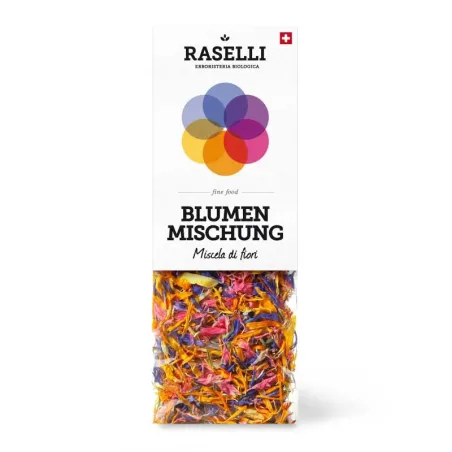
Ready-to-ship quantity: more than 20 pieces20+ in stock
Price:CHF7.90
The Valposchiavo is the southernmost valley in the canton of Graubünden. To the north, the four-thousanders of the Bernina massif tower up; to the south, the vegetation of the Valtellina is already growing. The valley is exceptionally sunny, sheltered from northerly winds, permeated by a mountain air that equips herbs and flowers with an aroma profile unattainable further north. It is no coincidence that Ricola has been buying its herbs here for over 40 years. In 1981, Reto Raselli took over his family's farm in Le Prese and began planting medicinal and mountain herbs. In 1993 the operation was certified with the Bio Bud label – one of the earliest certifications in Swiss herb growing. Today Reto Raselli is regarded as the herb king of Switzerland and a pioneer of organic herb growing in mountain regions. The Erboristeria Biologica Raselli grows over 30 plant species, harvests by hand during flowering time and dries gently at a maximum of 40 degrees Celsius – to preserve the active ingredients, colours and aromas of the flowers. Raselli dried flower blends are available at miniSchoggi.
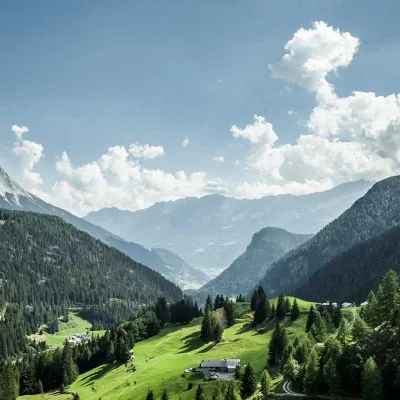
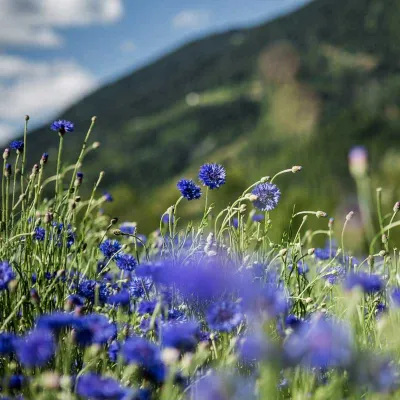
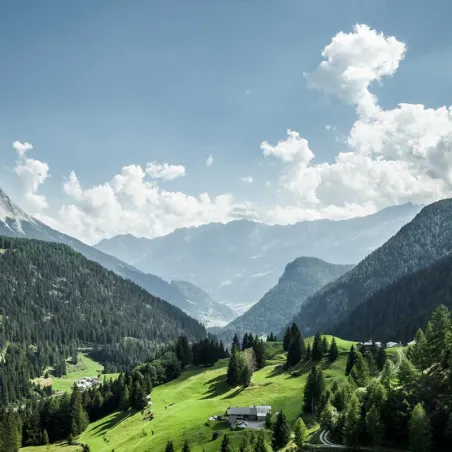
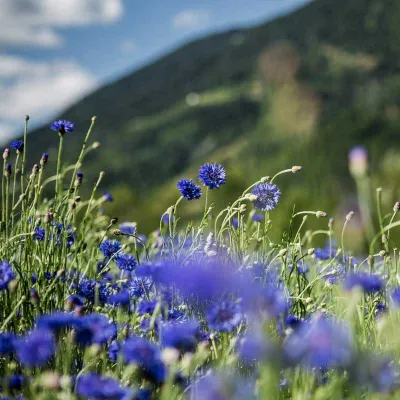
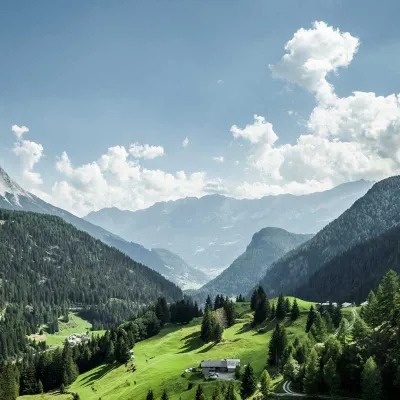
Le Prese lies at 1,000 metres above sea level, on the shore of the Lago di Poschiavo, in a valley that oscillates climatically between the Alpine world and the Mediterranean. The sunshine hours in the Valposchiavo significantly exceed most other Swiss regions at comparable altitude. The mountain air is dry and clean. The soils are mineral-rich, barely industrially altered, in the hands of families for generations who treat the land as what it is: the foundation for everything. The Valposchiavo is also reachable via the famous Rhaetian Railway, which is a UNESCO World Heritage Site – a valley the world knows, even if it remains geographically modest.
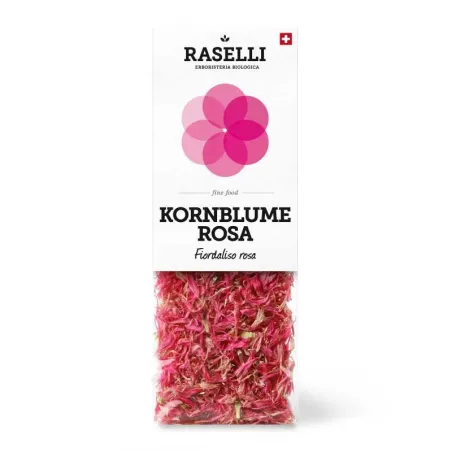
Reto Raselli grew up in this valley. In 1981 he took over his parents' farm – not as a business decision, but as the natural continuation of what the family had always done: farming, close to what the soil produces. What was new: the focus on medicinal and mountain herbs native to the region but barely commercially developed. In the first year Raselli harvested 450 kilograms. Today the annual yield exceeds 40 tonnes. That is not linear growth – it is the consequence of four decades of consistent quality work. On the 15 hectares of the farm, more than 25 different herb and flower species grow: arnica, orange mint, marigold, cornflower, sunflower, sage, mallow, lady's mantle and even edelweiss – the alpine flower that refines Raselli's tea blends and is cultivated in this quality barely anywhere else.
In 1993 Reto Raselli had the farm certified according to Bio Suisse guidelines and received the Bud label. That was early: organic farming in Switzerland in the early 1990s was far from mainstream. The decision was a matter of conviction, not a market question. No use of chemical aids, no pesticides, no synthetic fertiliser. Weeding is done by hand – time-intensive but necessary, because a healthy soil cannot take chemical shortcuts and because Raselli knows precisely that the quality of the flowers depends directly on the quality of the soil they grow in.
The Bio Bud is the strictest Swiss organic label: it goes beyond the legal minimum organic requirements and concerns not only the avoidance of chemicals but also soil health, circular economy, crop rotation and the use of beneficial organisms. For a mountain farm growing 25 to 30 different plant species, that is a considerable requirement – each plant has its own physiology, its own sensitivity to pests, its own demands on soil and water balance. Raselli has met these requirements continuously for over 30 years. Reto Raselli was also president of the Swiss Working Group for the Promotion of Herb Growing in Mountain Regions for almost 40 years – a role that testifies to his contribution to the entire industry far beyond his own farm.
Flowers are harvested when they are open – in their flowering period, at the point when colour, aroma and active ingredients are most intense. This sounds obvious but is not: industrial harvesting often follows logistics schedules, not the flowering calendar. At Raselli the plant determines the harvest time. Not all flowers open simultaneously; not all varieties are at their optimum at the same moment. This means: repeated walking of the fields, selective harvesting by condition, no mechanical sweeping. Much is harvested by hand – slower, more expensive, but more precise than any machine.
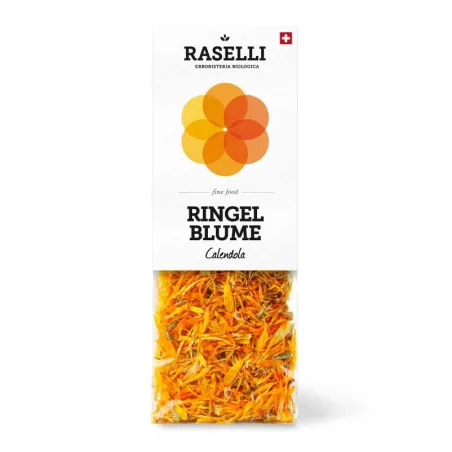
What follows is the decisive phase: drying. Raselli dries all herbs and flowers at a maximum of 40 degrees Celsius – a temperature at which the cells can close slowly without dyes, essential oils or other value-giving constituents being destroyed. Above 40 degrees, thermolabile compounds begin to denature: pigments fade, aromas volatilise, the characteristic constituents that distinguish one flower from another are lost. A marigold dried at 40 degrees is bright orange. One dried at 80 degrees is pale. Raselli chooses the gentle method – not because it is cheaper, but because the result is better.
The entire processing – growing, harvesting, drying, blending, packaging – takes place on the farm in Le Prese. Short routes, complete control, no quality loss through intermediate steps. Previously Raselli had to send blends to Milan for packaging. Today everything happens in-house, under the eyes of the same people who grew the plants.
That a farm with 15 hectares in the mountain region of Graubünden has become one of Switzerland's best-known herb producers is not self-evident. Ricola has been a customer of Raselli for over 40 years – a mark of trust that needs few words. The confectionery manufacturer sources mallow, sage and lady's mantle from Le Prese for its secret herb blends. Coop distributes various Raselli teas under the Naturaplan and Pro Montagna labels throughout Switzerland. Together with top chef Oskar Marti, known as 'Chrüteroski', Raselli developed herb bags that release their aroma during cooking to meat, vegetables and pasta. The Prix Montagne honoured Raselli for outstanding achievements in mountain regions.
What connects all these partners is the quality of the raw materials: an organically grown flower or herb leaf from the Valposchiavo has a different aroma profile, more intense colour and higher essential oil content than a comparable conventionally produced product. That is measurable – and it is the reason Raselli remains a sought-after partner after decades.
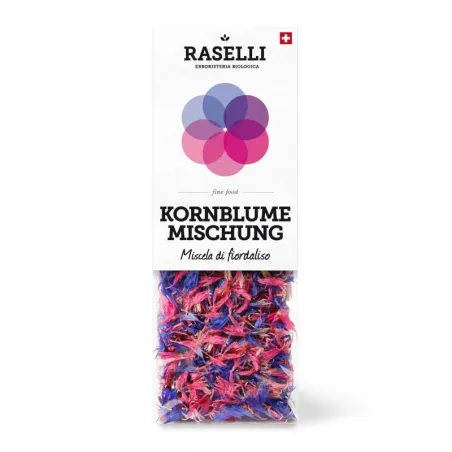
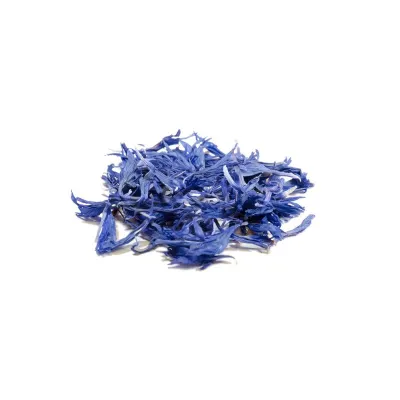
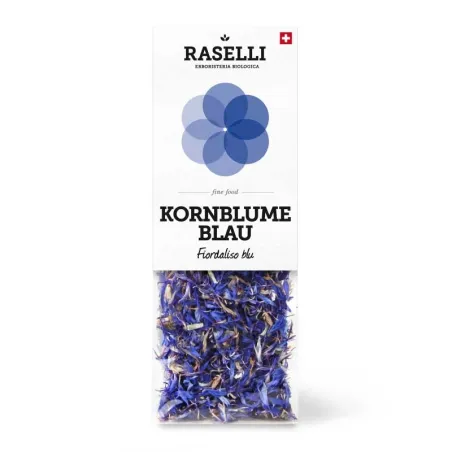
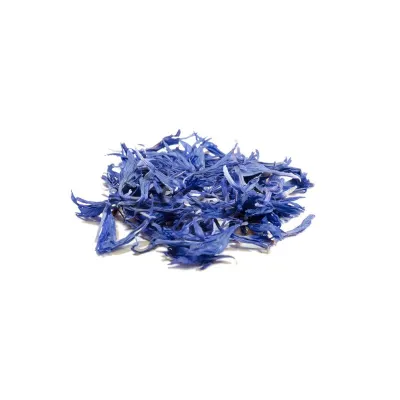
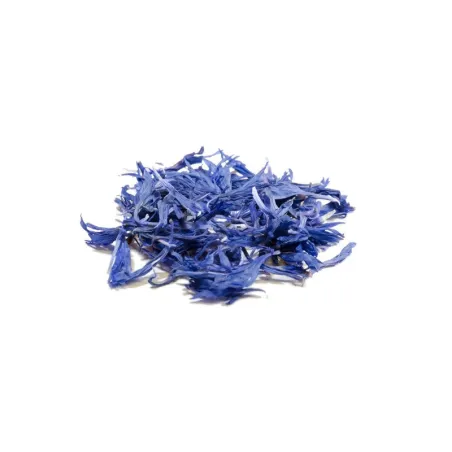
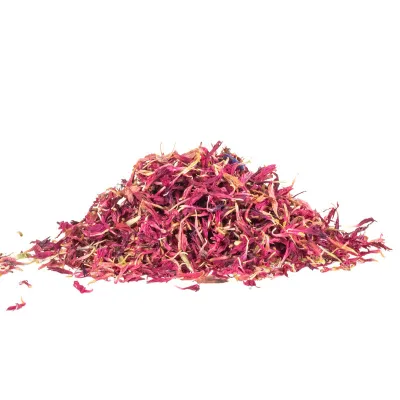
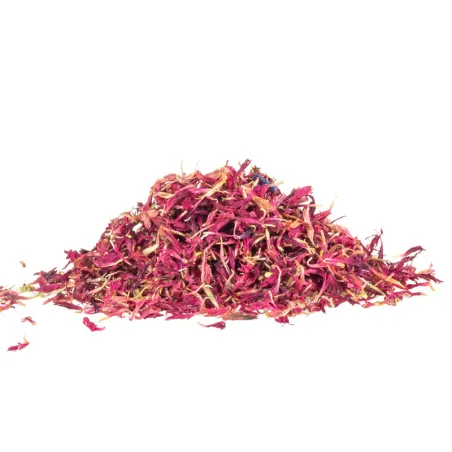
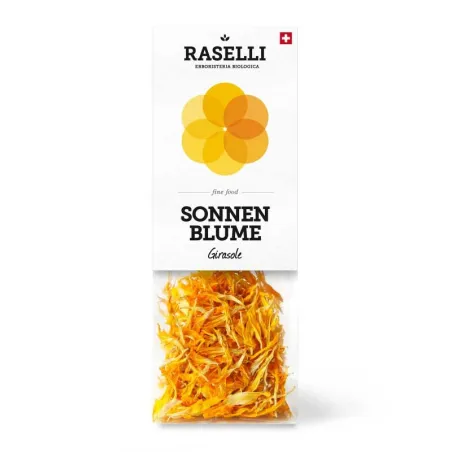
Dried flower blends from certified organic growing in the Valposchiavo: marigold, cornflower in blue and pink, sunflower and further seasonal flowers depending on harvest and season. Hand-harvested during flowering time, gently dried at a maximum of 40°C, packaged at the own farm in Le Prese. Bio Bud certified, without pesticides, without chemical aids.
Dried flower blends · Bio Bud certified · Hand-harvested · Valposchiavo, Graubünden
A dried flower on a dessert is more than decoration – it is a quality signal. It says: this cake, this plate, this pâtisserie piece was garnished with ingredients from a controlled, organic growing operation, harvested at the right time and gently processed. Raselli flowers are bright in colour because drying at a maximum of 40 degrees preserves the pigments. They are aromatic because the Valposchiavo soil and mountain climate produce flowers more intense than lowland goods. And they are Bio Bud certified – Switzerland's strictest organic label, held continuously on the Raselli farm for over 30 years.
Dried flowers are also a versatile tool in the kitchen and confectionery: as a topping on ice cream and mousse, as a decorative element on cakes and cupcakes, as a colour accent in white chocolate coating, as edible decoration on pralines and petits fours. The dried flower does not change through contact with moisture as quickly as a fresh one – it retains its shape and colour longer and is therefore suitable for decorations that do not need to be applied in the last minutes before serving. miniSchoggi carries Raselli dried flower blends because edible decoration deserves the same quality commitment as the ingredients of the creation itself. The range includes various dried flower blends and is continuously expanded.
1981. Le Prese, Valposchiavo. 450 kilograms of herbs. Today 40 tonnes. Always Bio Bud. Raselli.