
Apple Tart with a Crunchy Caramelised Almond Topping
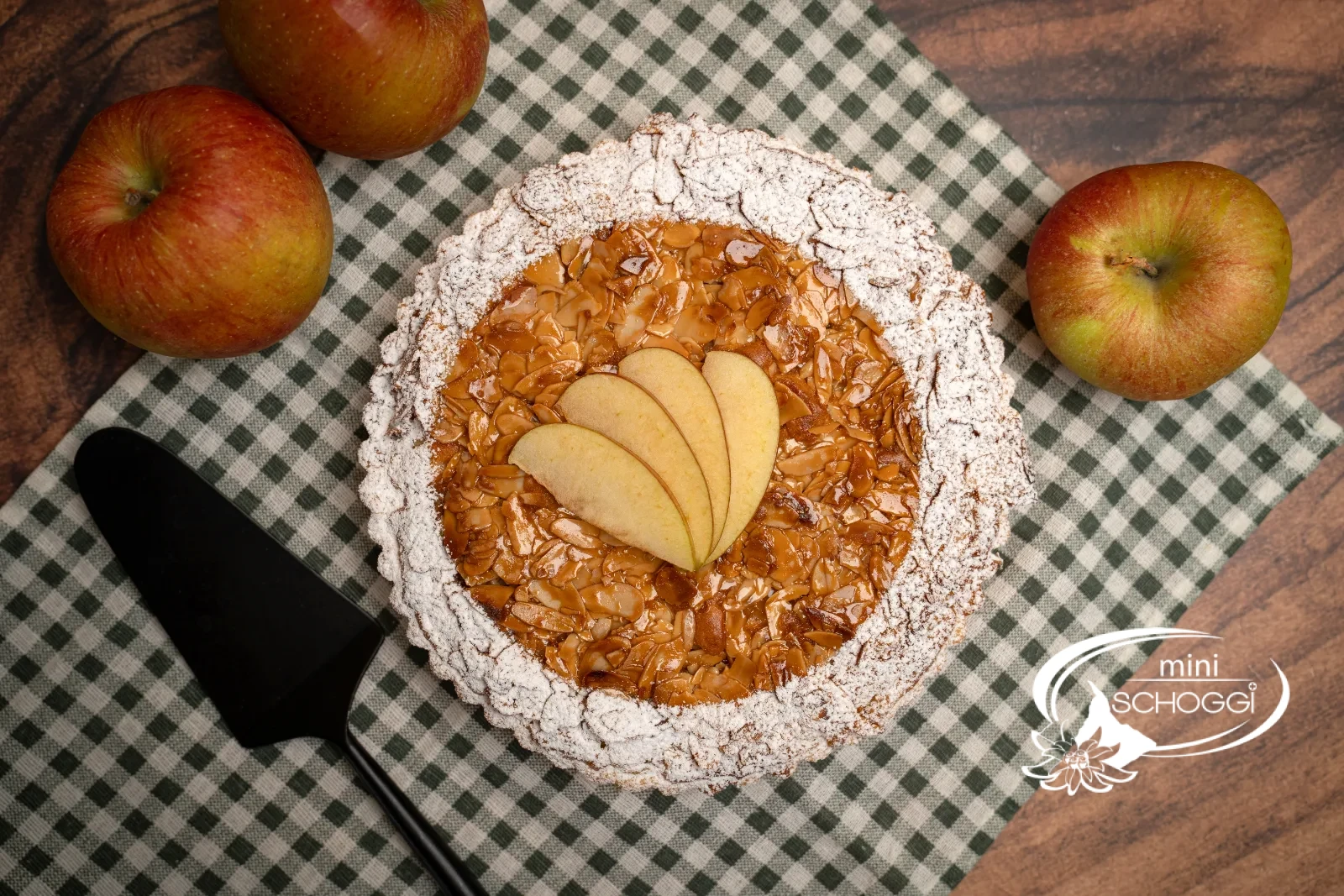
Crumbly, juicy and crunchy on top
Quantity1 tart Ø 20 cm (8 pieces)
Active time45 min.
Total time2 hrs. 15 min.
GlutenEggMilkNuts (almonds)
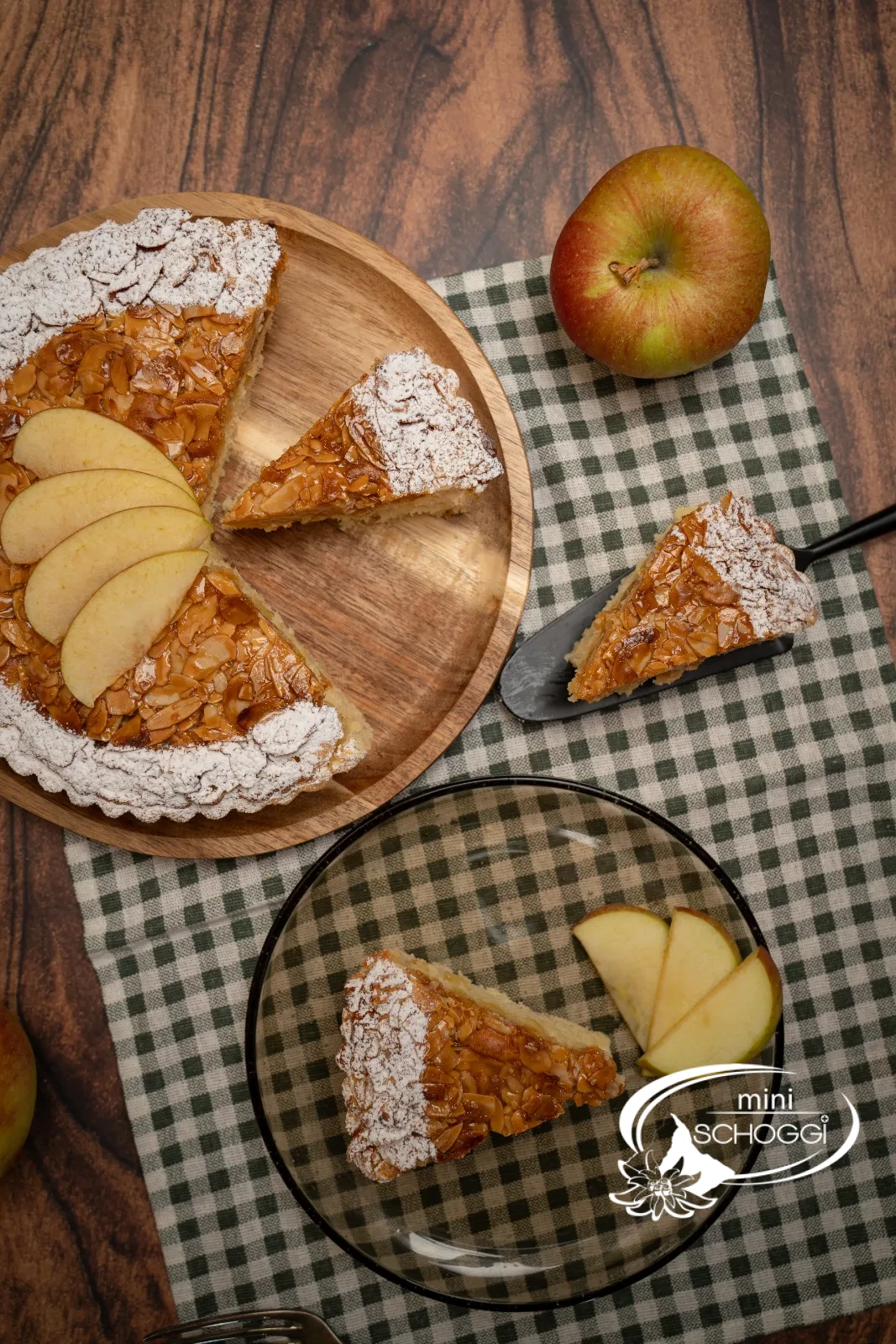
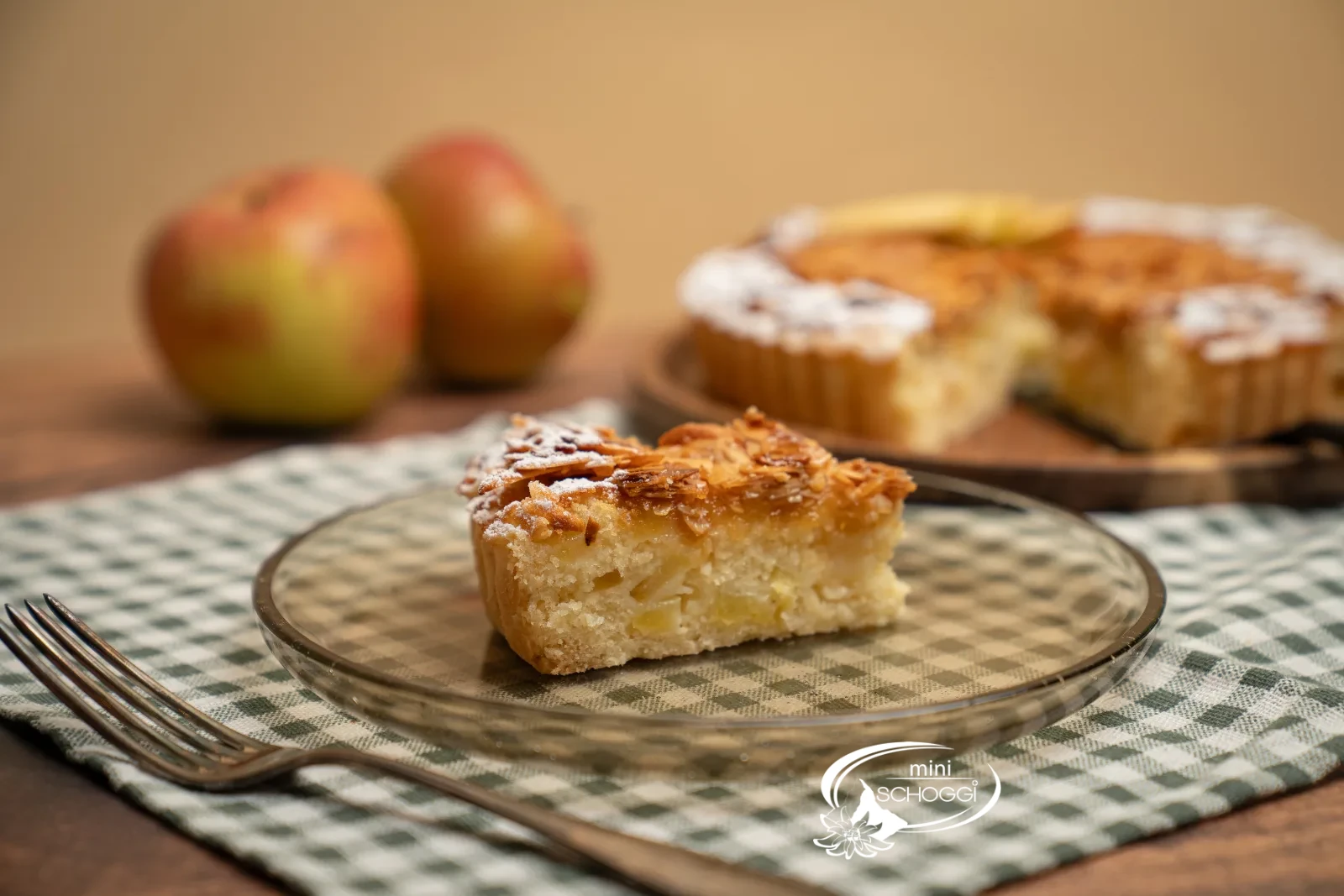
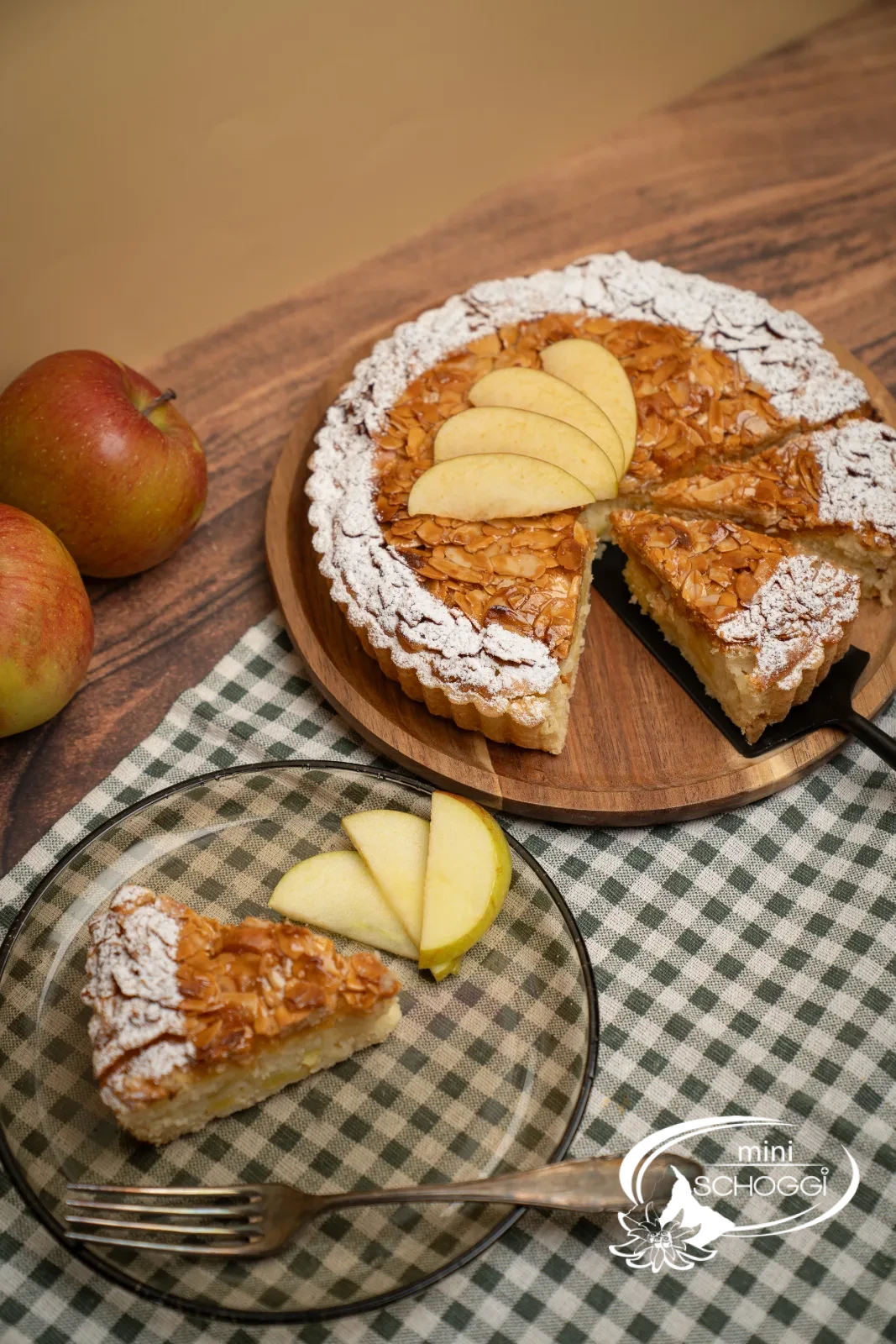
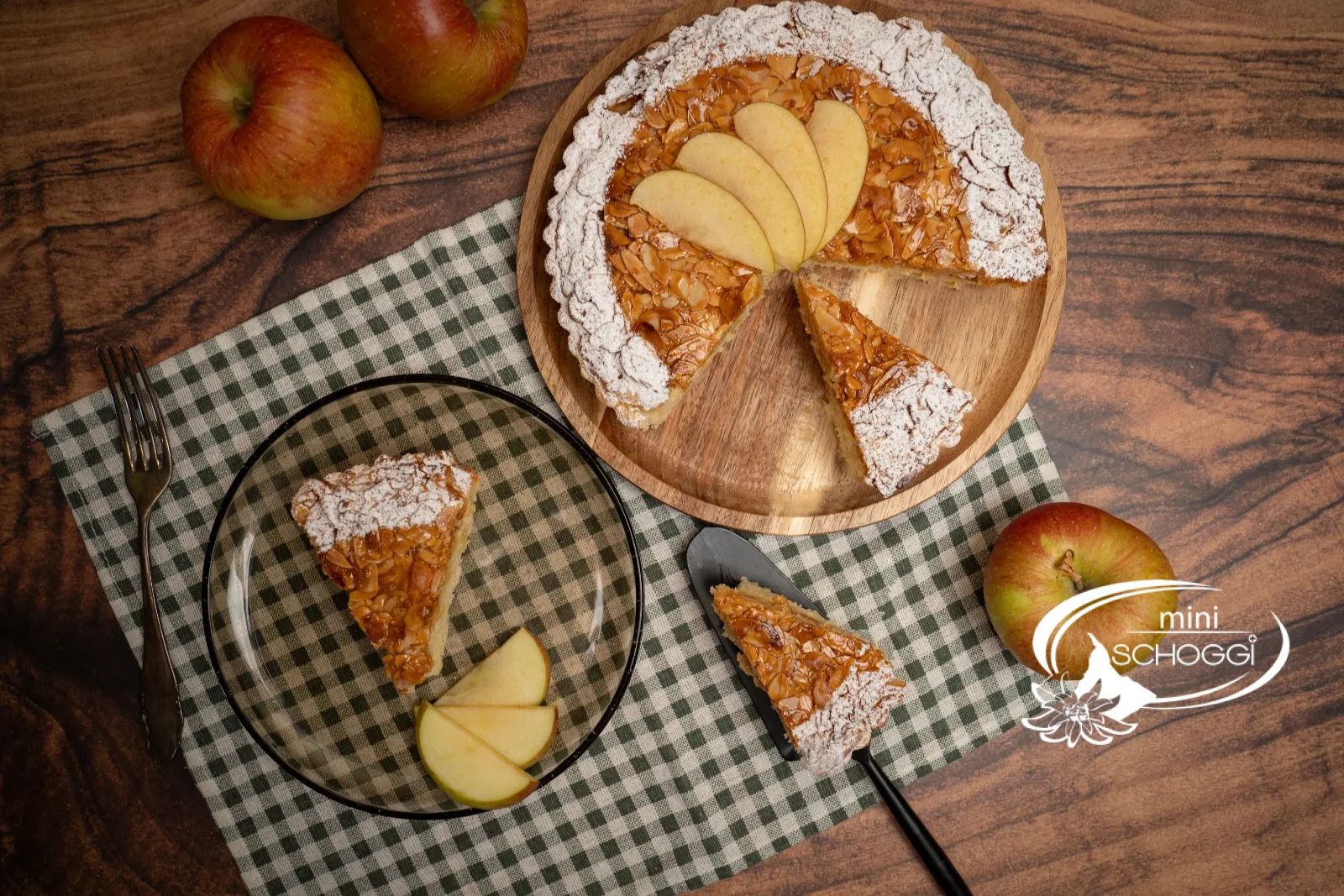
There are cakes you recognise by their sound. This apple tart is one of them: when the knife glides through the topping of caramelised almonds, it crackles softly, and underneath a soft, juicy apple filling appears.
The tart is made of three parts that are prepared one after another and finally go into the oven together. First the shortcrust pastry, which is left to rest in the fridge for an hour. Then the filling, which is poured into the base and topped with fresh apple slices. And lastly the crunchy topping: sugar, Glucose syrup, honey and butter are cooked to 113 °C and mixed with flaked almonds, then spread over the apples while still hot.
No need to fear the caramel. With a Sugar thermometer it is not a guessing game but a number you read off, just like with tempering couverture, where in the end everything comes down to the Thermometer too.
The apple tart keeps for five days at room temperature and tastes almost even better on the second day, because the filling has had time to develop. Have fun baking it.
Ingredients
Quantity:
Shortcrust pastry
90 gButter, at room temperature
60 gGranulated sugar
2 pinchesSalt
20 gWhole egg (beaten)
150 gWhite flour
Apple filling
180 gApples (approx. 1½ medium, tart)
45 gButter, at room temperature
25 gGranulated sugar (part 1), for softening the apples
35 gWhole egg (beaten)
40 gMilk
100 gWhite flour
20 gGranulated sugar (part 2), for the mixture
Crunchy topping
30 gHoney
30 gGranulated sugar
30 gGlucose syrup
30 gButter
70 gAlmonds, flaked (white)
Finishing
as neededIcing sugar for dusting
Step by step
If you are in a hurry: the compact recipe card further down sums it all up.
Shortcrust pastry
1
Beat butter, sugar and salt until fluffy
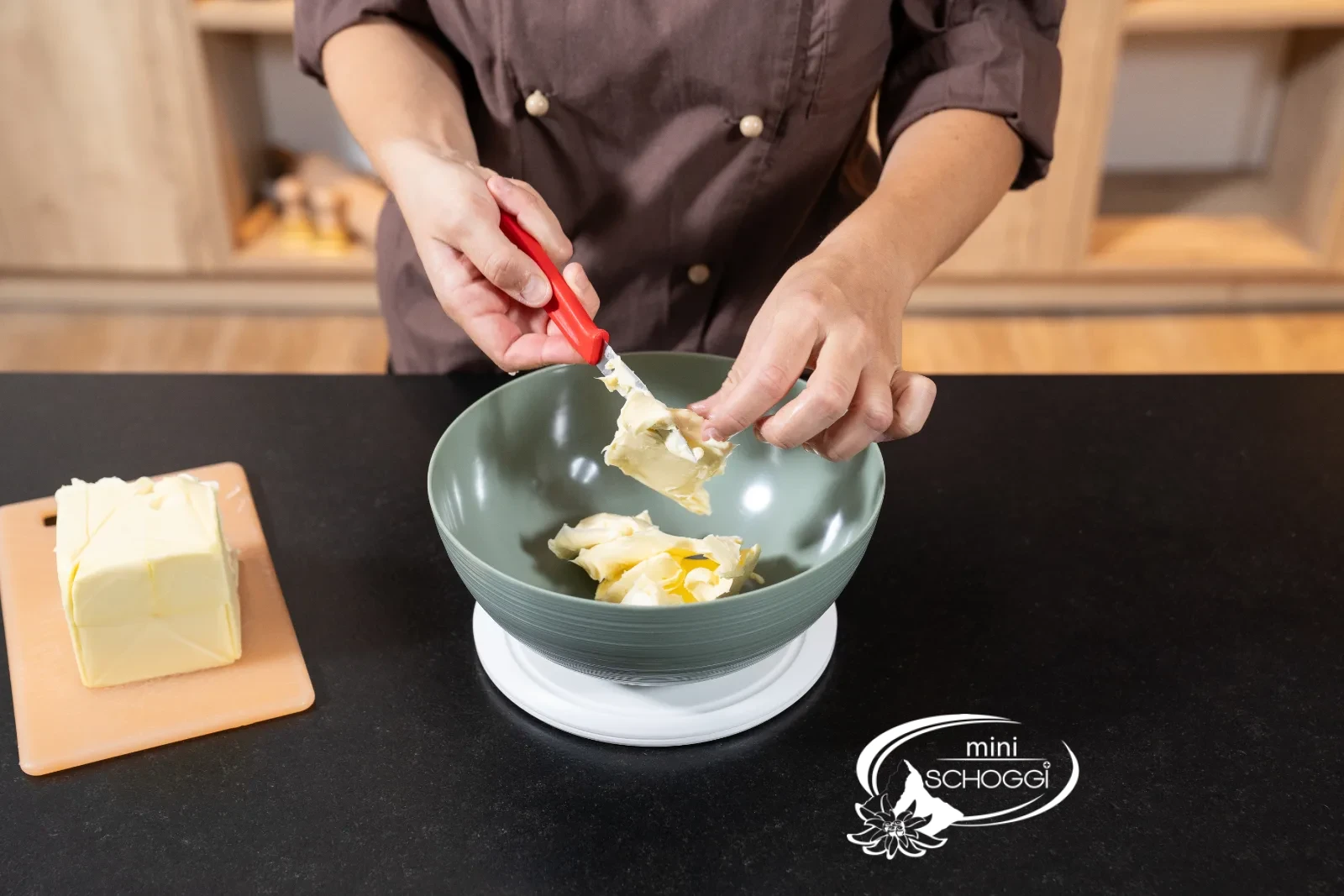
Weigh out the butter and cut it into cubes, that way it softens evenly. It has to be at room temperature: your finger should press a dent into it without resistance. Cold butter takes in no air, and without air the dough turns crumbly instead of short.
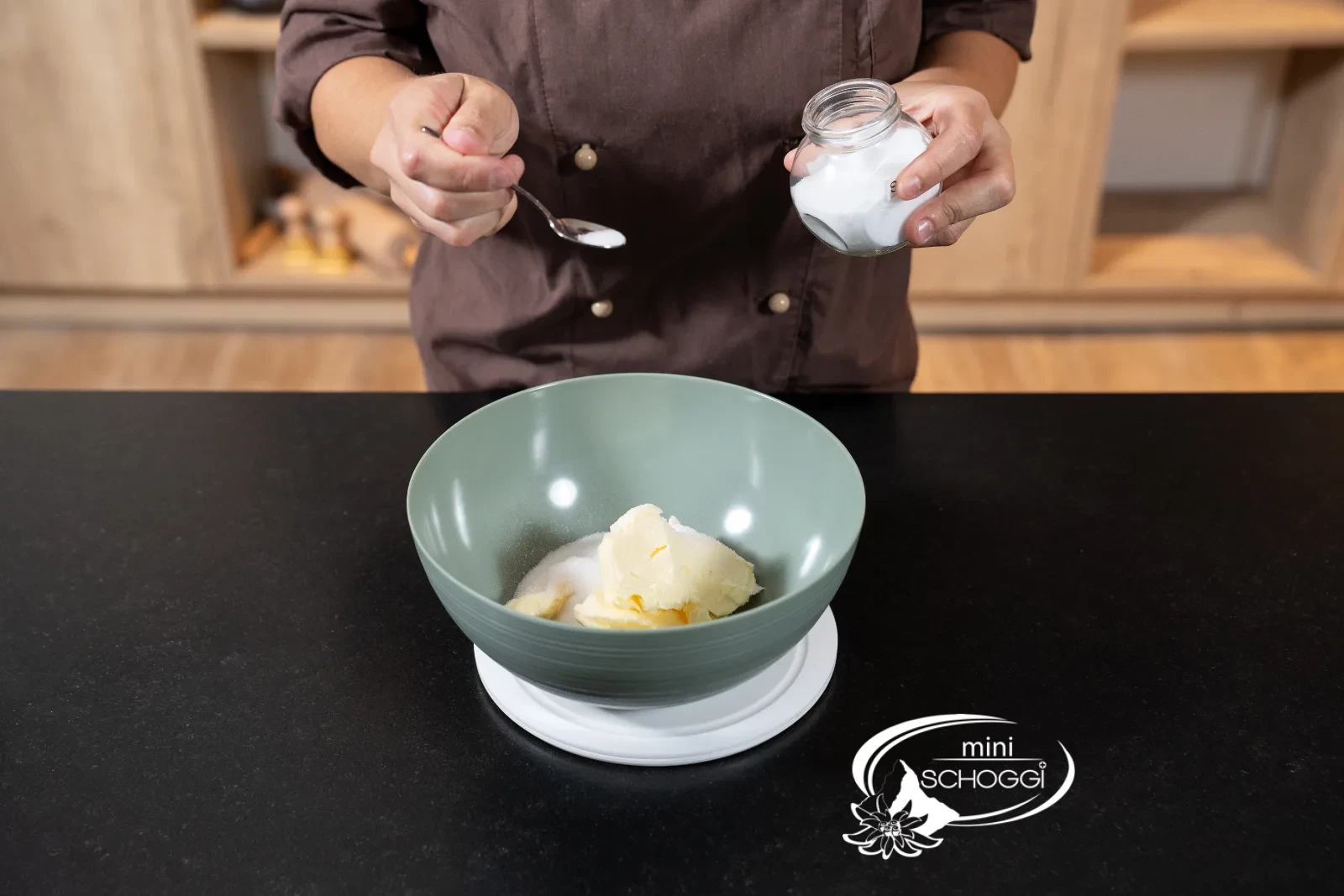
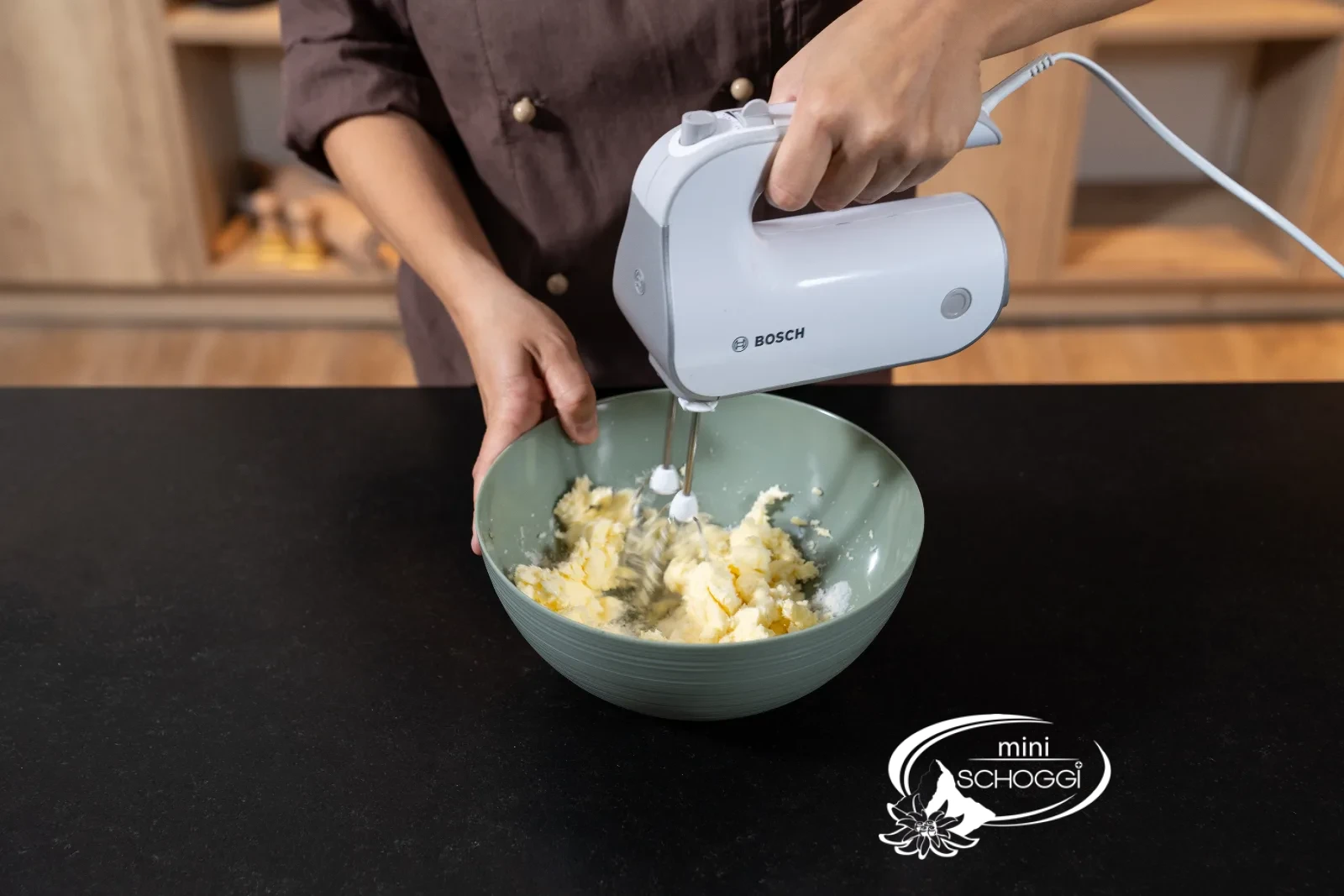
Add the granulated sugar and the two pinches of salt and beat everything with the hand mixer until the mass has clearly turned lighter and visibly gained volume. That takes two to three minutes, anything shorter is not enough.
2
Add egg and flour
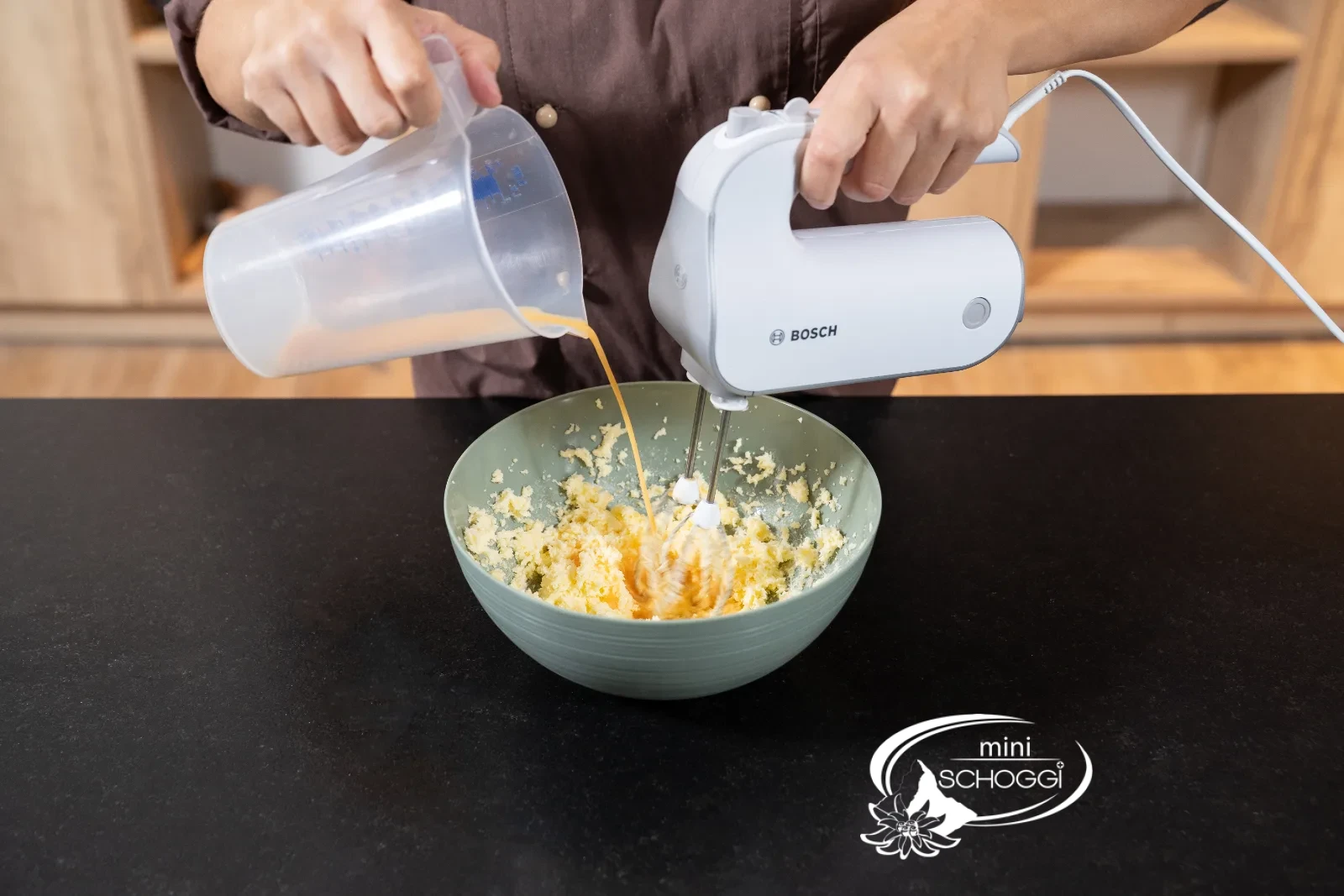
Pour the whisked whole egg in a thin stream while the mixer is running. Tipping it all in at once is the most common mistake: egg and butter then separate, the mass looks curdled and never turns smooth again.
Then add the White flour and mix only until no dry flour is visible anymore. From here on the rule is: the less you work it, the shorter the dough becomes. Whoever kneads for long builds up gluten, and a shortcrust pastry with gluten turns hard and shrinks during baking.
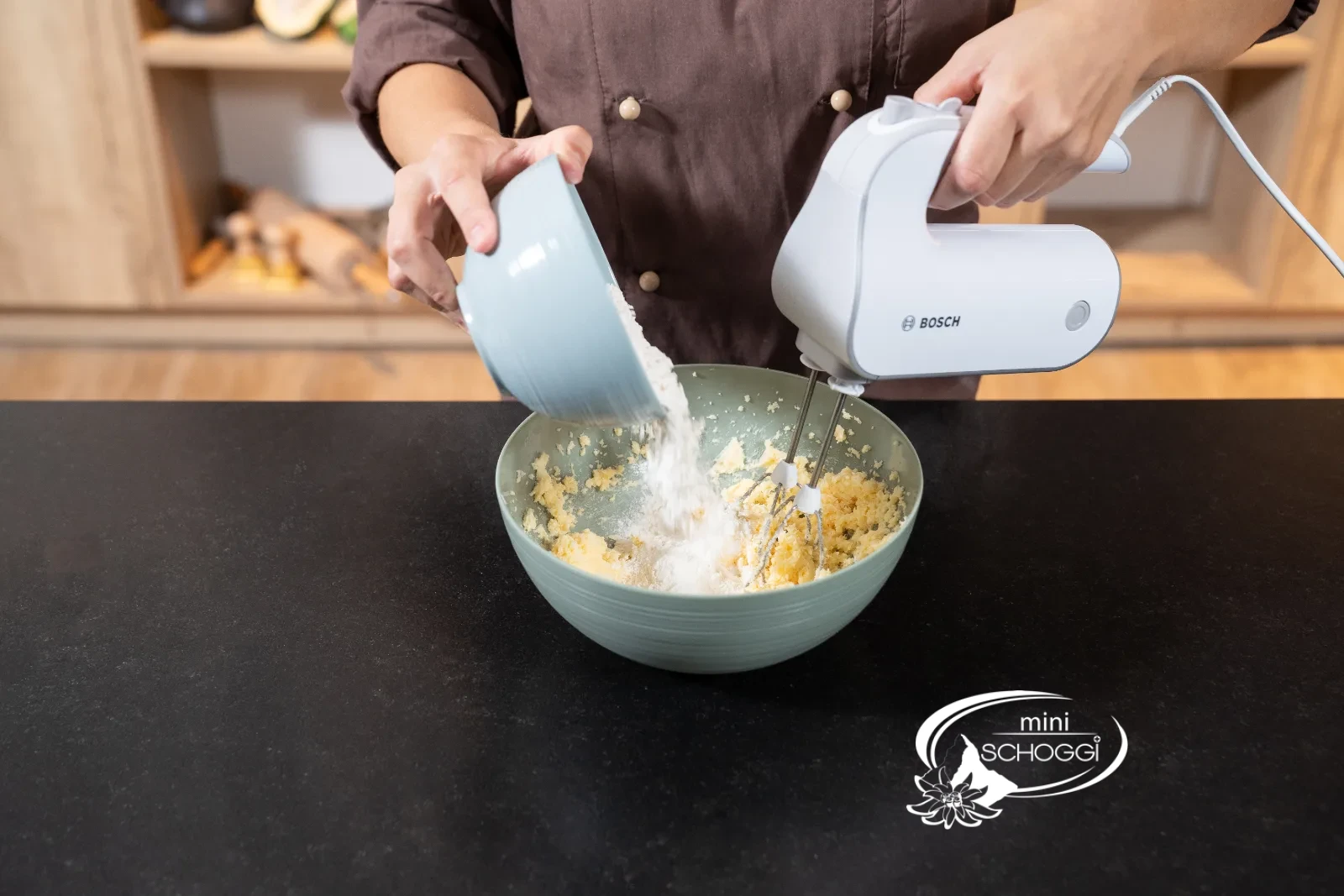
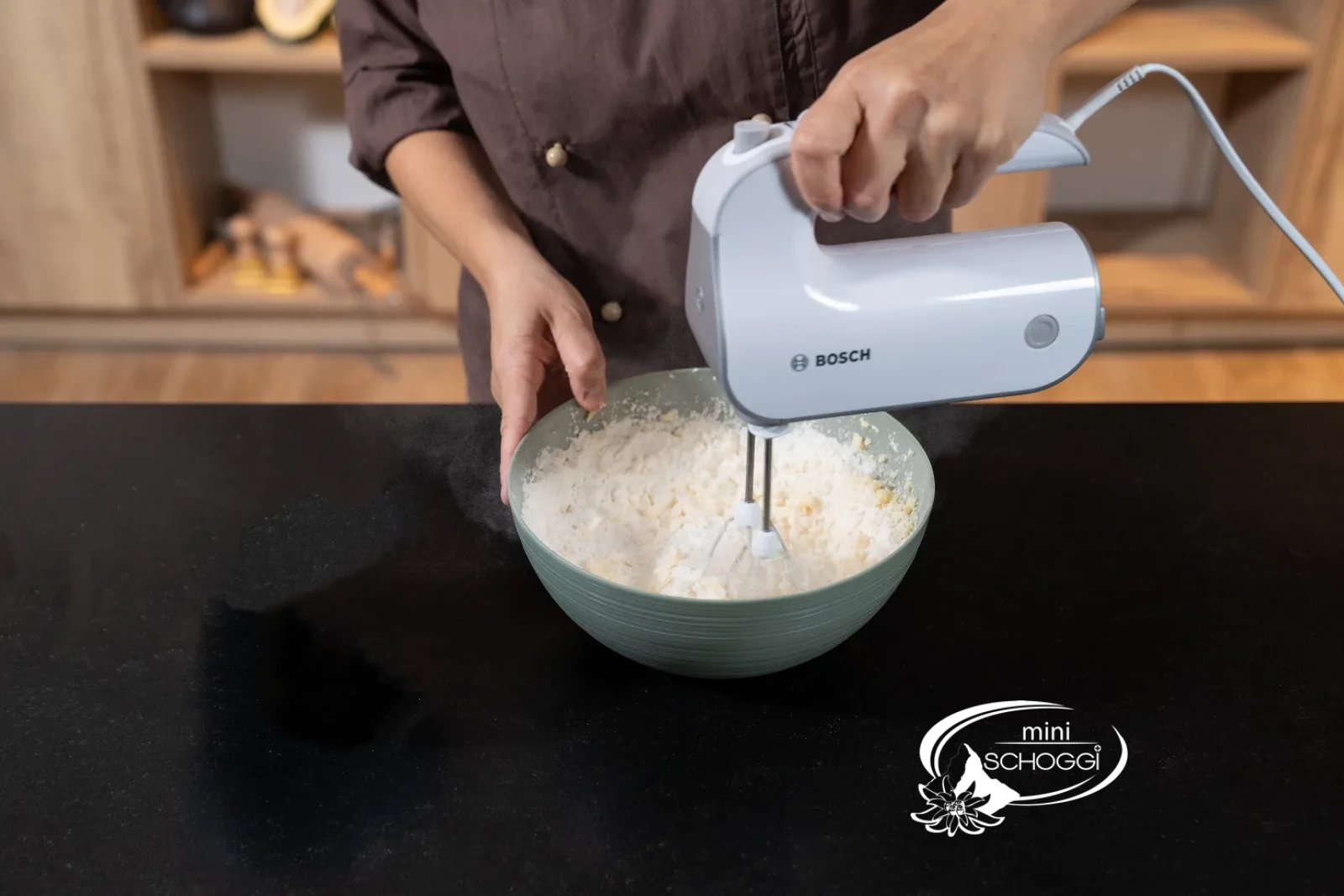
3
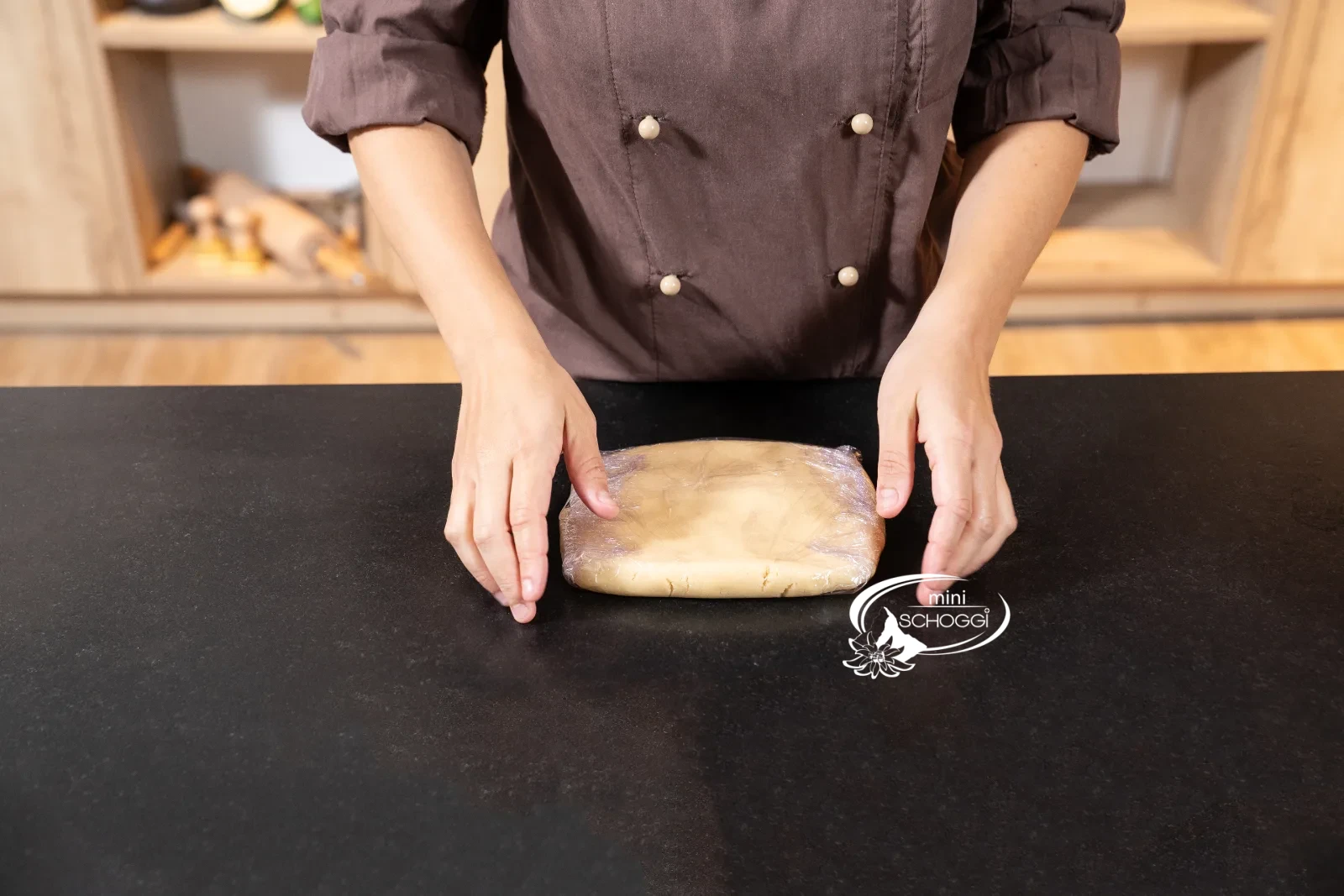
Bring together, wrap flat, chill for an hour
Bring the crumbly mass together briefly with your hands until a dough forms, press, do not knead. Place it on cling film and press it into a flat, as square as possible slab.
Flat is not for looks: a slab chills all the way through in an hour, a ball only on the outside, and afterwards it rolls out without effort. Into the fridge for about an hour.
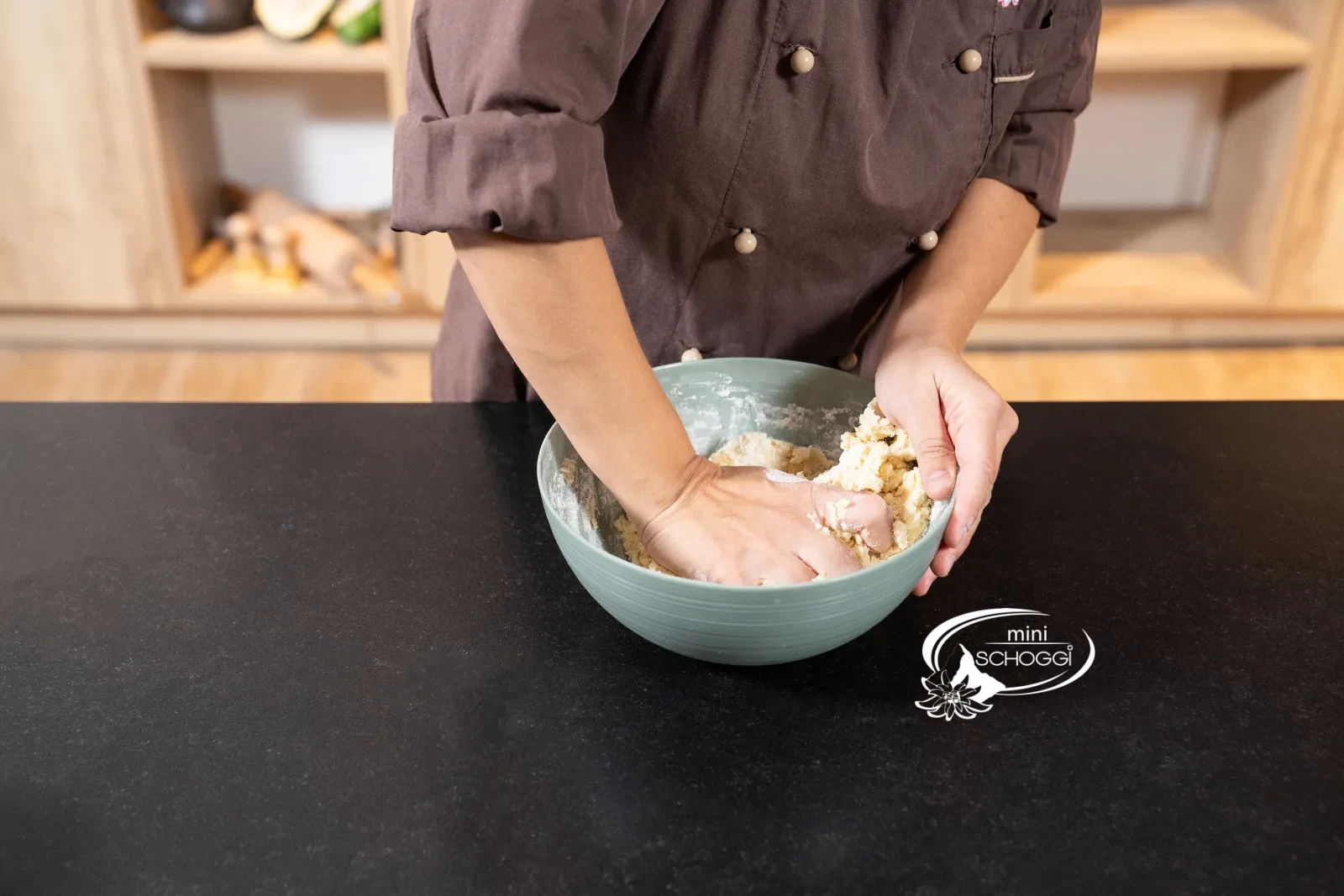
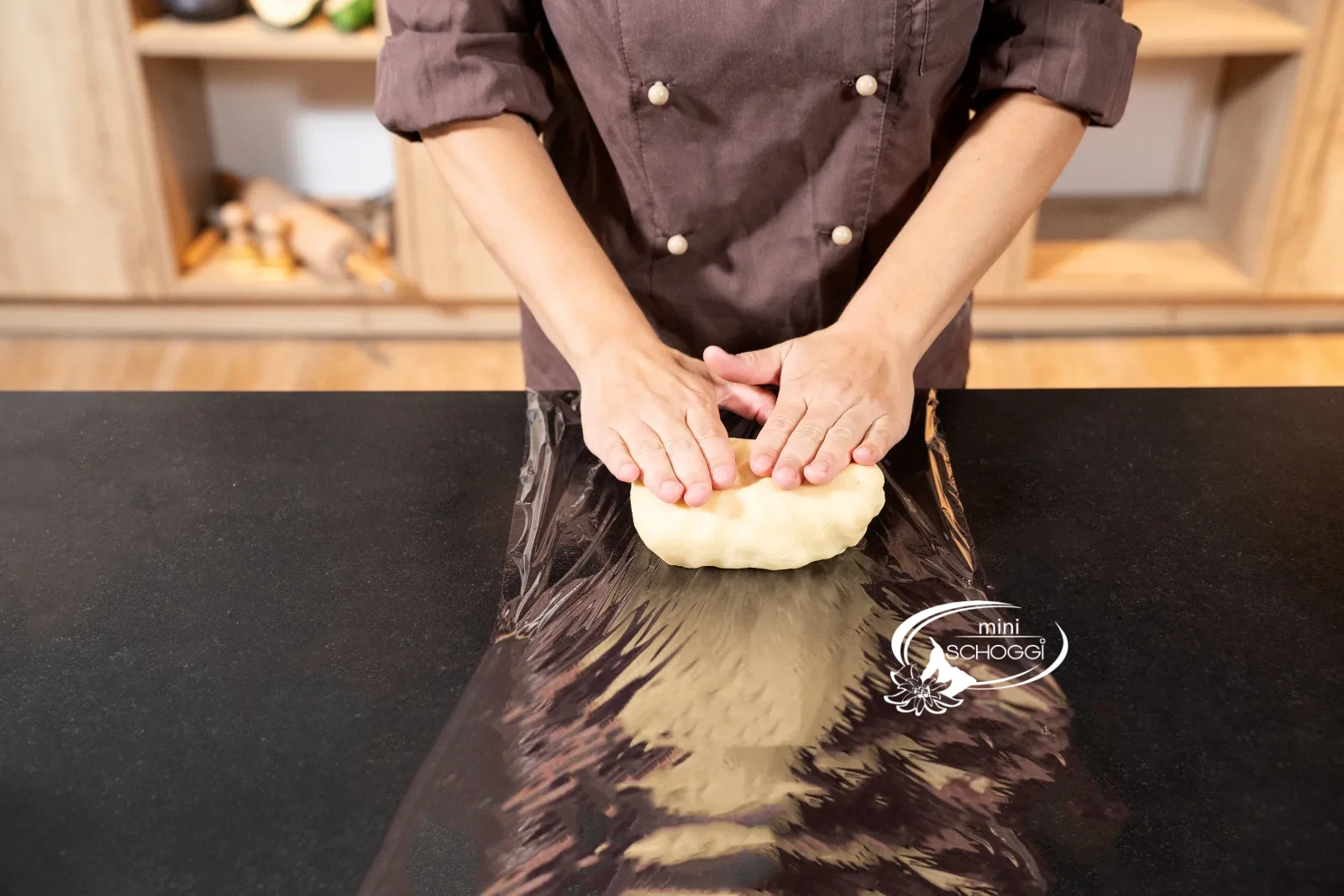
Prepare and line the tin
1
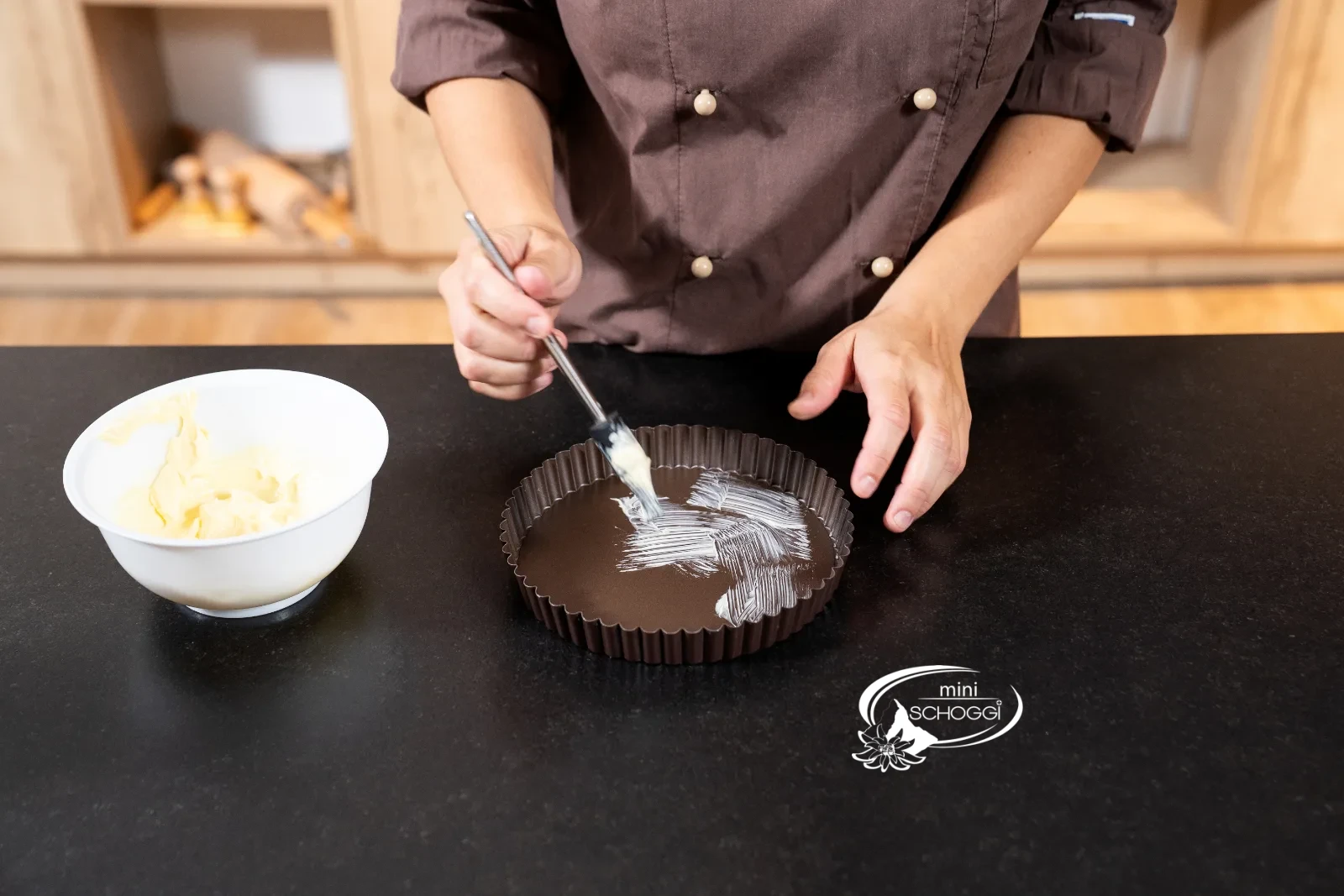
Grease the tin, dust with flour and roll out the dough
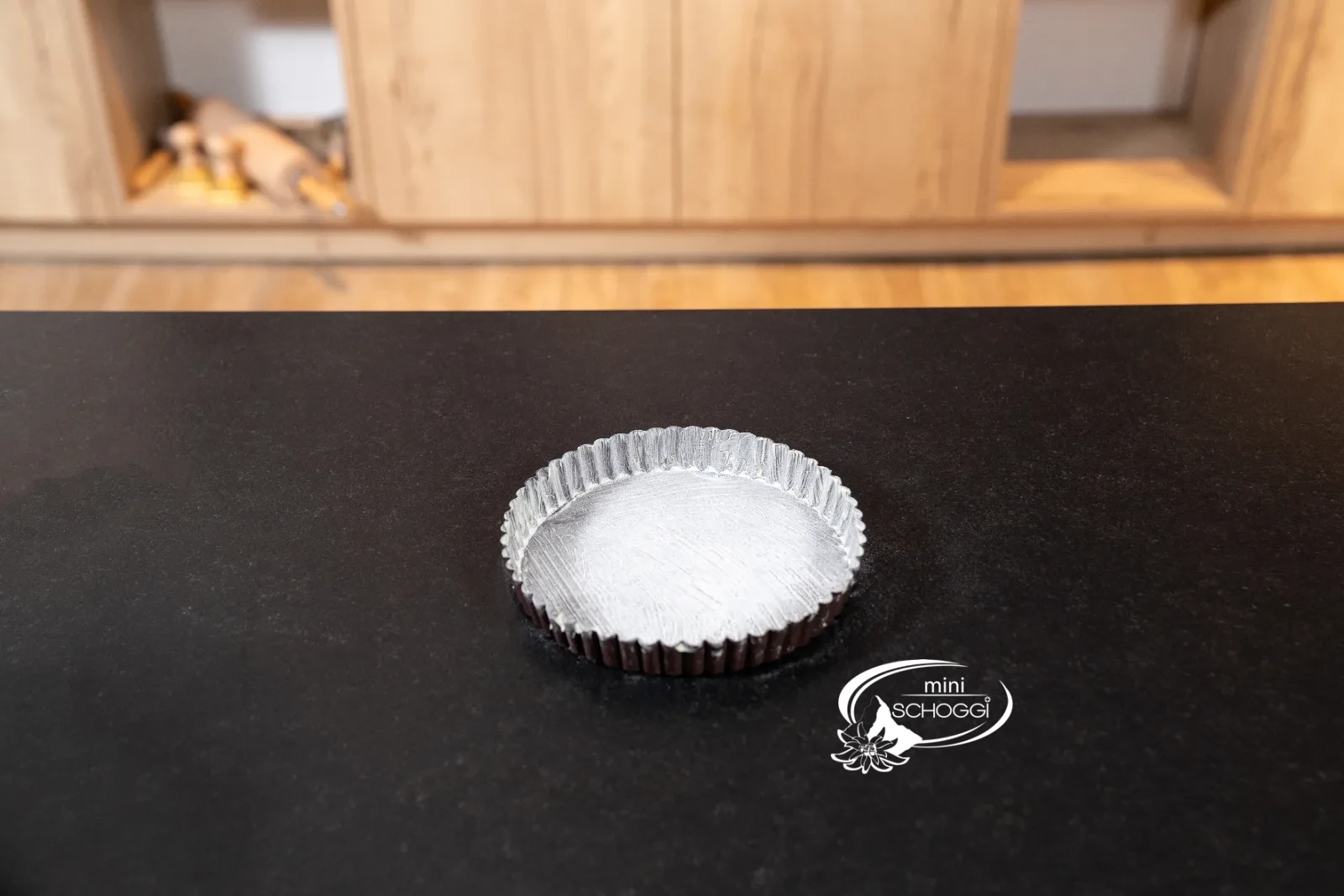
Brush the Tart tin thinly with soft butter using the brush, including the grooves at the edge, otherwise the dough sticks there. Add a little flour, turn the tin and tap out the excess flour. Butter and flour together are your insurance that the baked tart will release later.
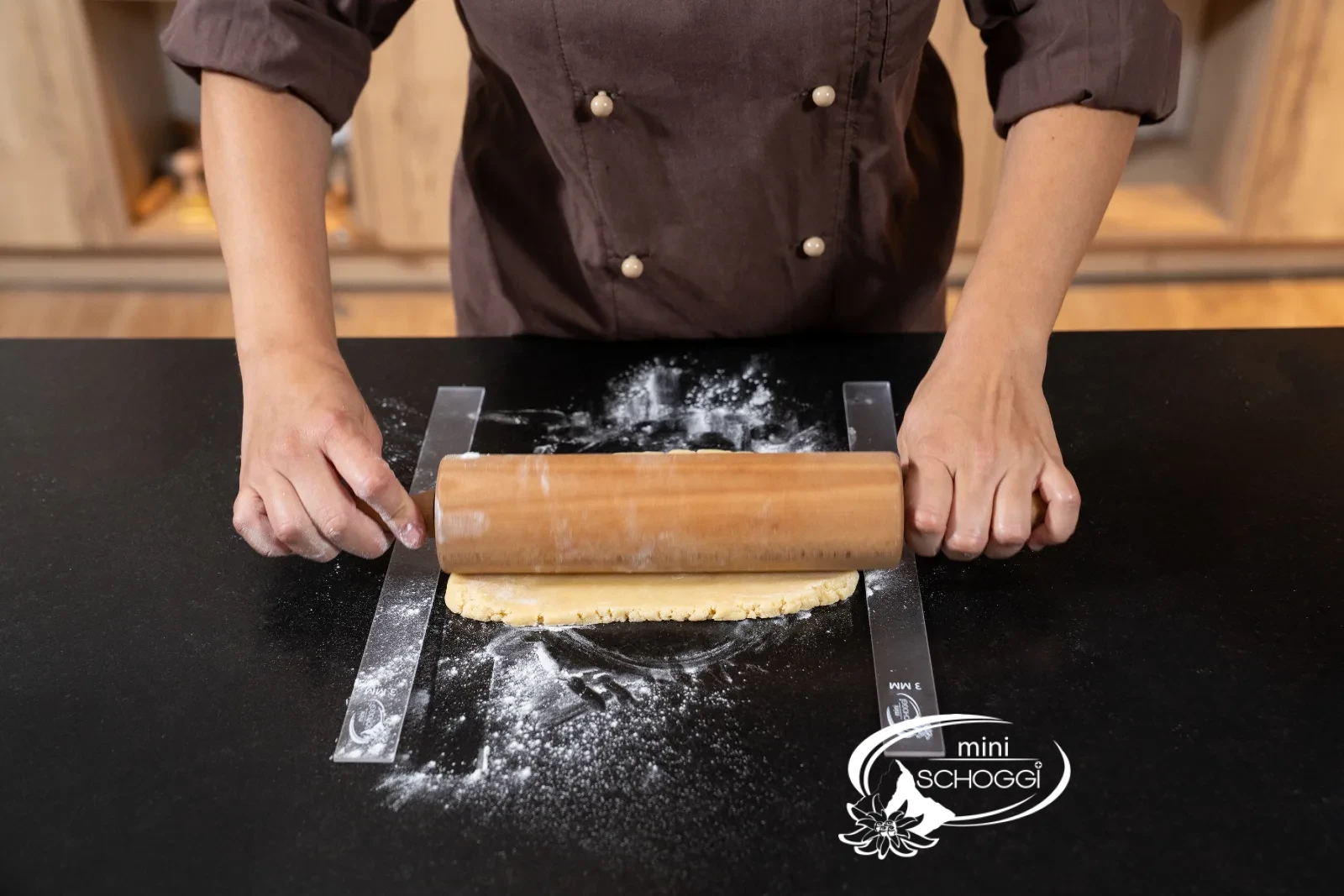
Roll out the chilled dough on a little flour. If you have rolling guides, place them on the left and right: they give the same thickness everywhere, and an even thickness means an even baking time. Around 3 to 4 millimetres is right.
2
Cut out a circle and line the tin
Using a ring slightly larger than the tin, cut a circle out of the dough, that way you have enough dough all around for the edge and only have to trim off a little afterwards.
Lift the circle carefully and lay it into the tin. Press it in without stretching, especially carefully into the corner between base and edge: if air stays there, the edge sinks during baking. Finally press the dough into the grooves of the edge and cut off the overhang with the knife along the rim. Put the lined tin back into the fridge until the filling is ready, cold dough holds its shape while baking. You do not need to blind bake the base: it goes raw under the filling, and base, filling and crisp topping bake together at the end.
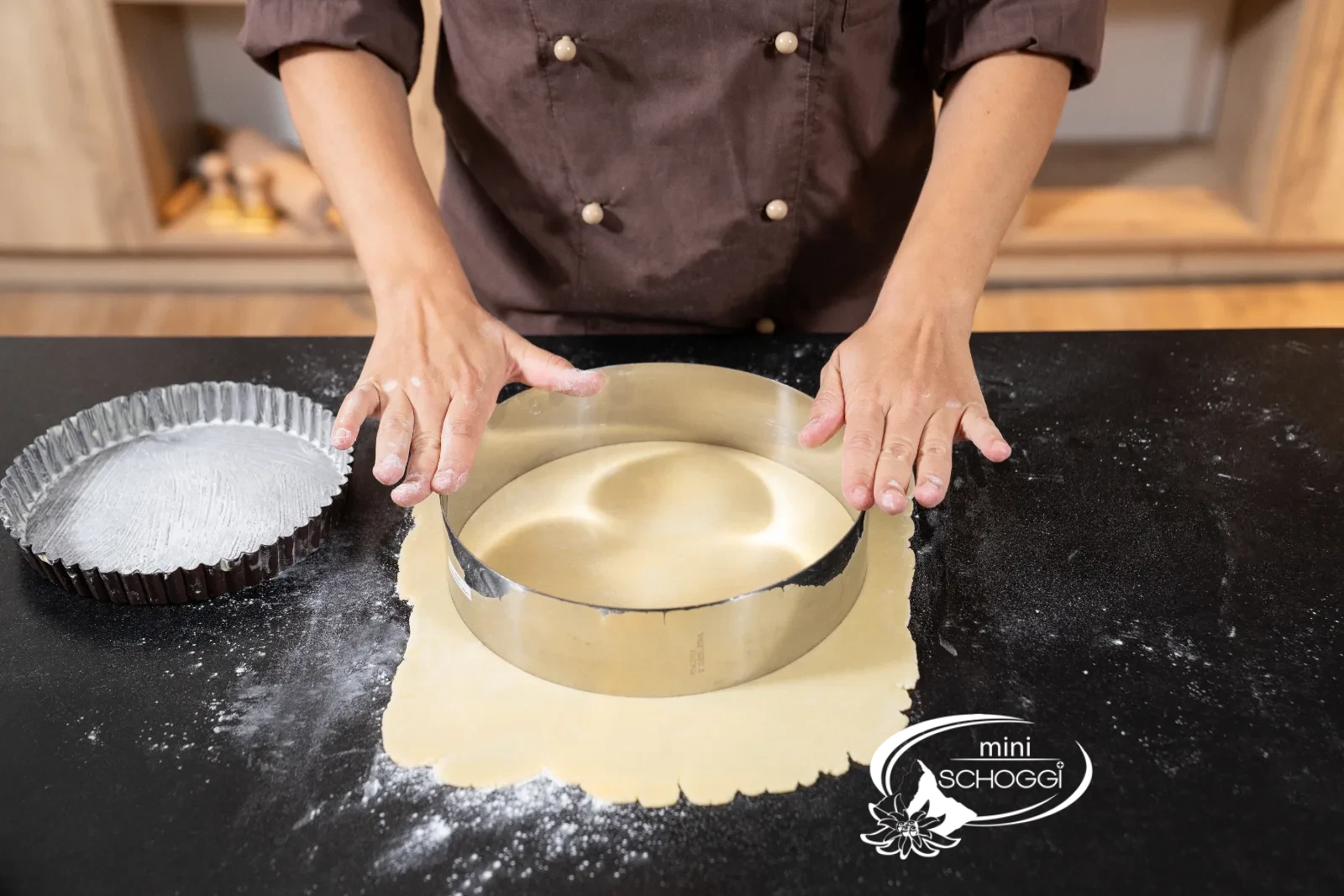
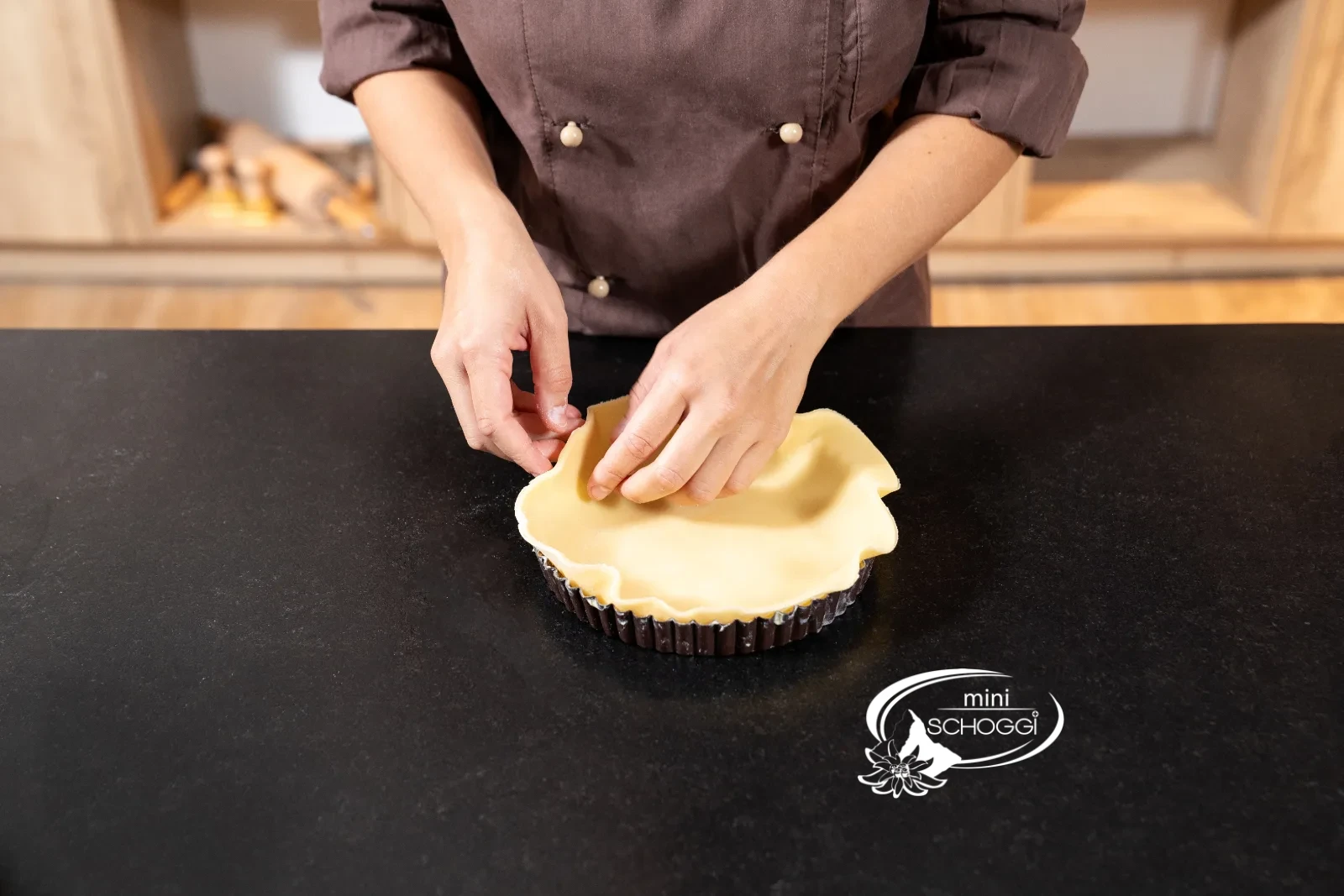
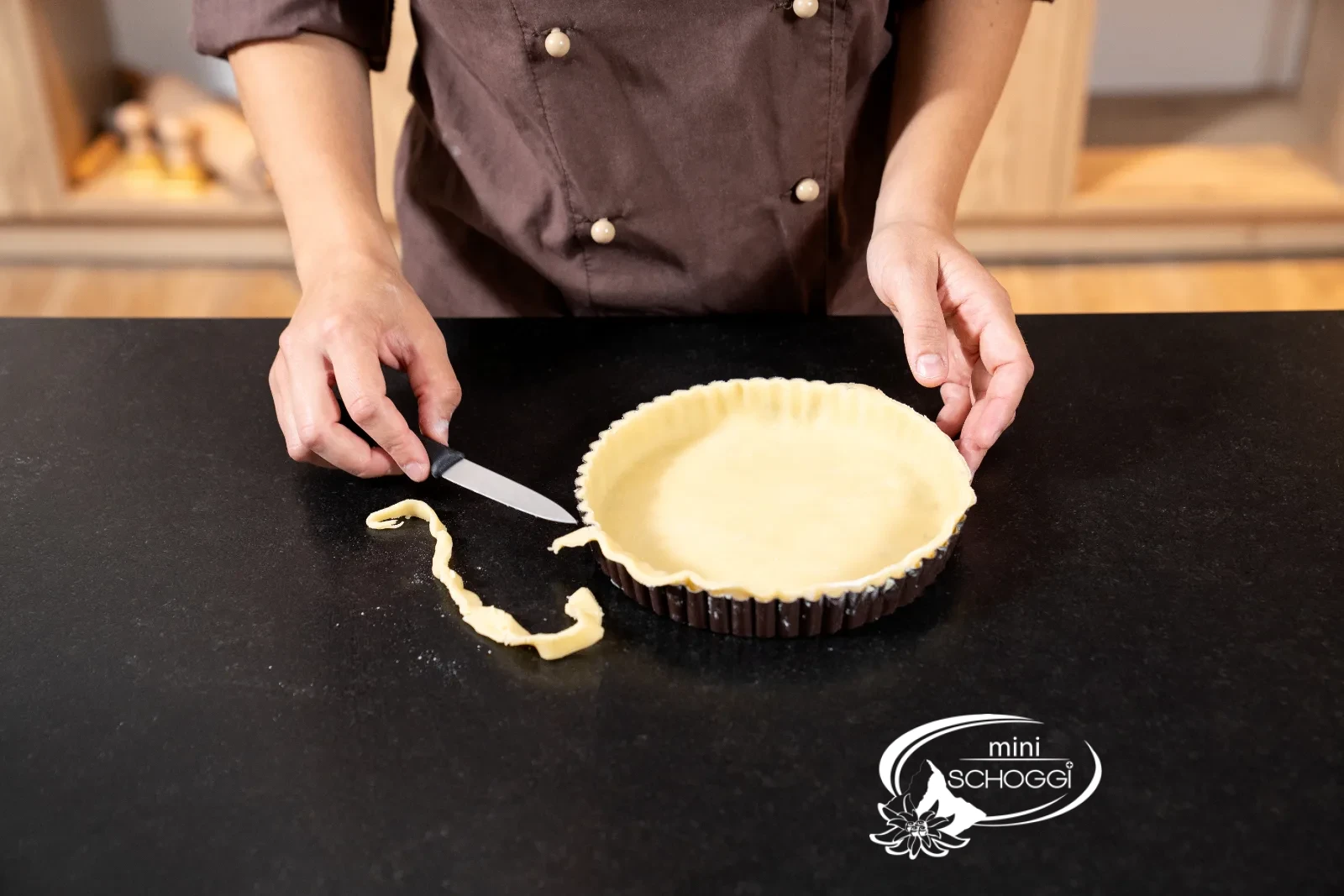
Cook down the apples
1
Cut the apples and cook until soft
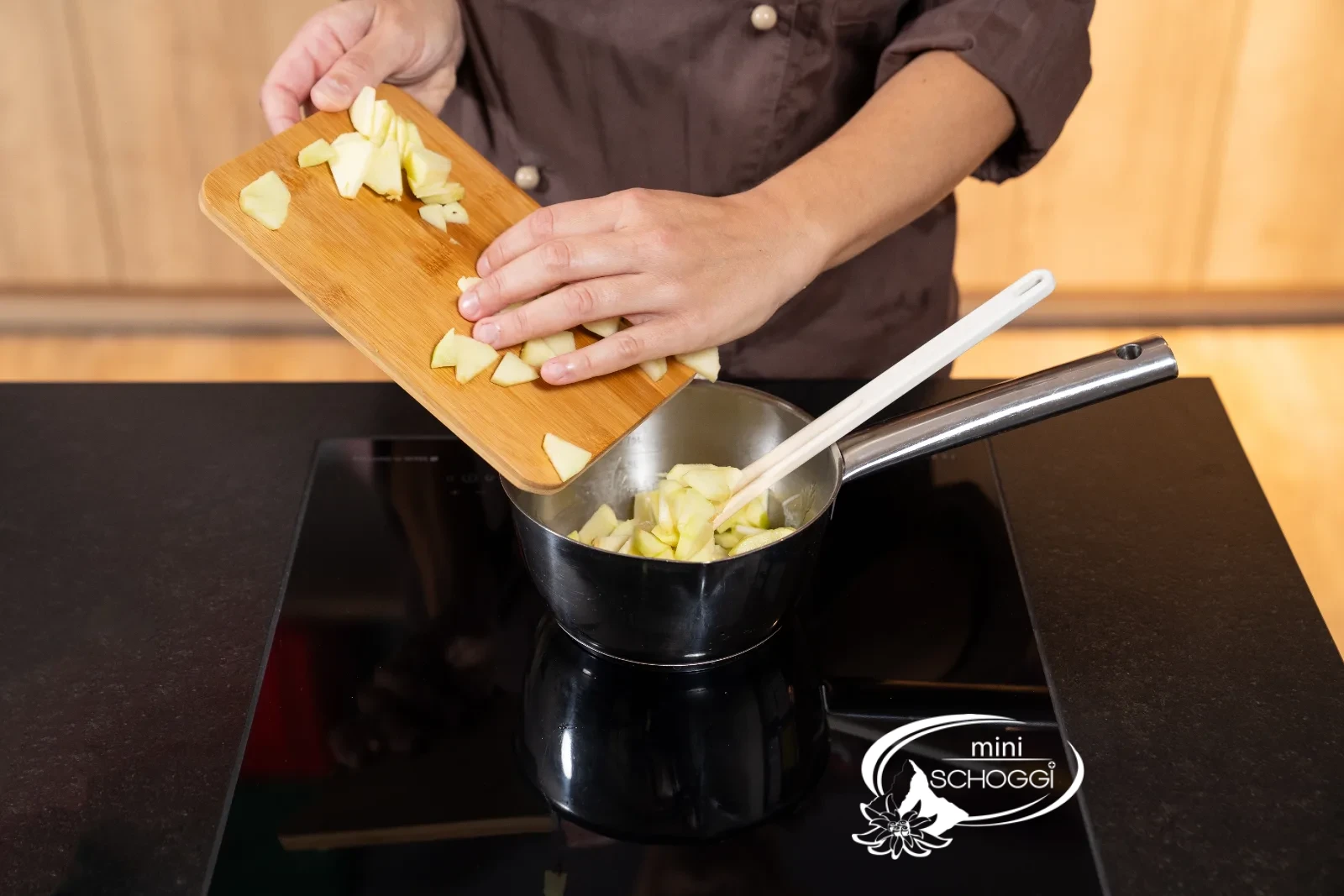
Peel the apples, remove the core and cut them into even cubes. Even here means: they all turn soft at the same time.
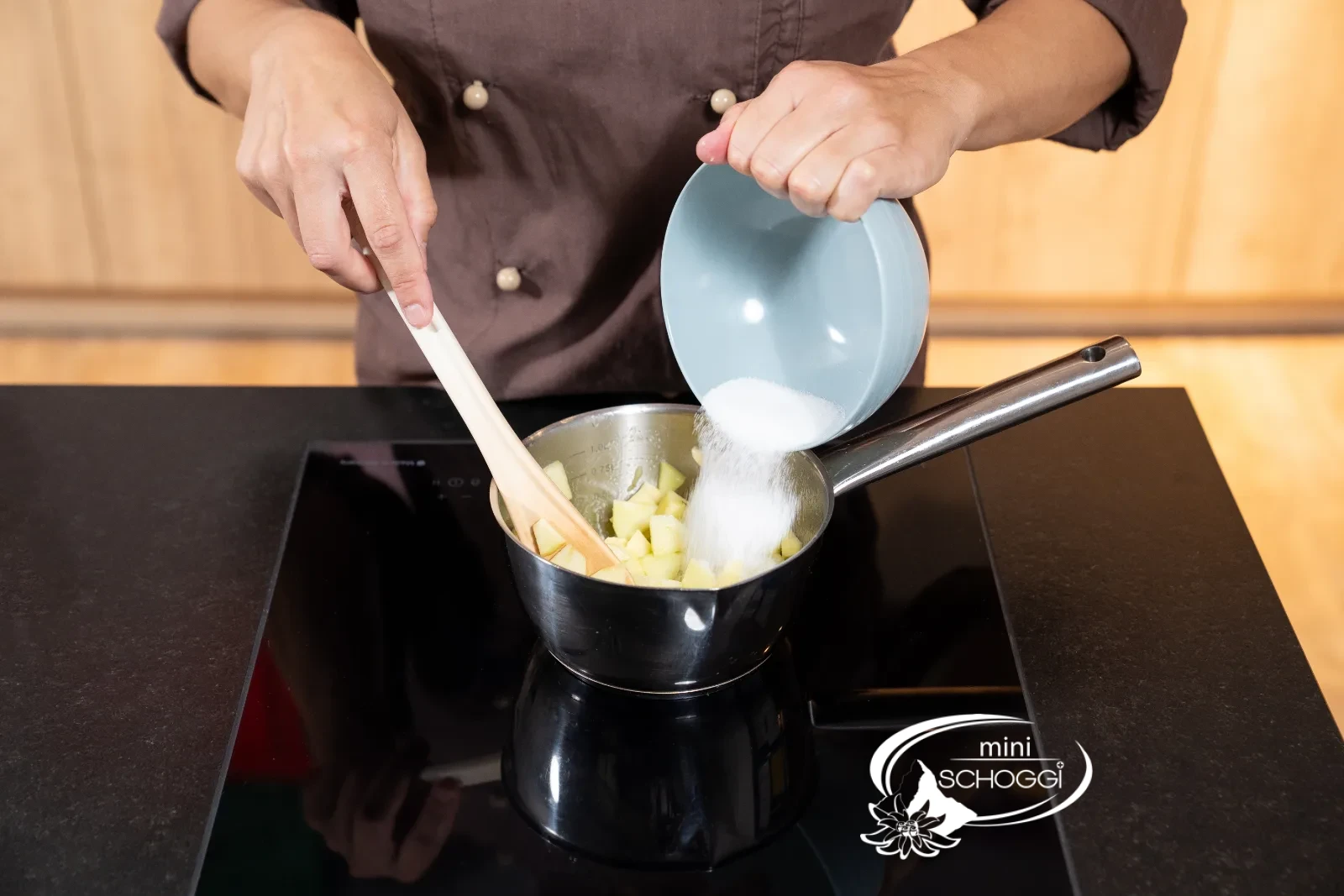
Put the cubes into a pan, sprinkle 25 g of the granulated sugar over them and cook them down over medium heat. Stir now and then. The apples should only turn slightly soft, they finish baking later in the tart, and whoever cooks them to mush here will have no pieces left in the filling.
Transfer them to a bowl and let them cool until they are lukewarm at most. This is not optional: hot apples melt the beaten butter in the mass, and the air you are about to beat in would be gone again.
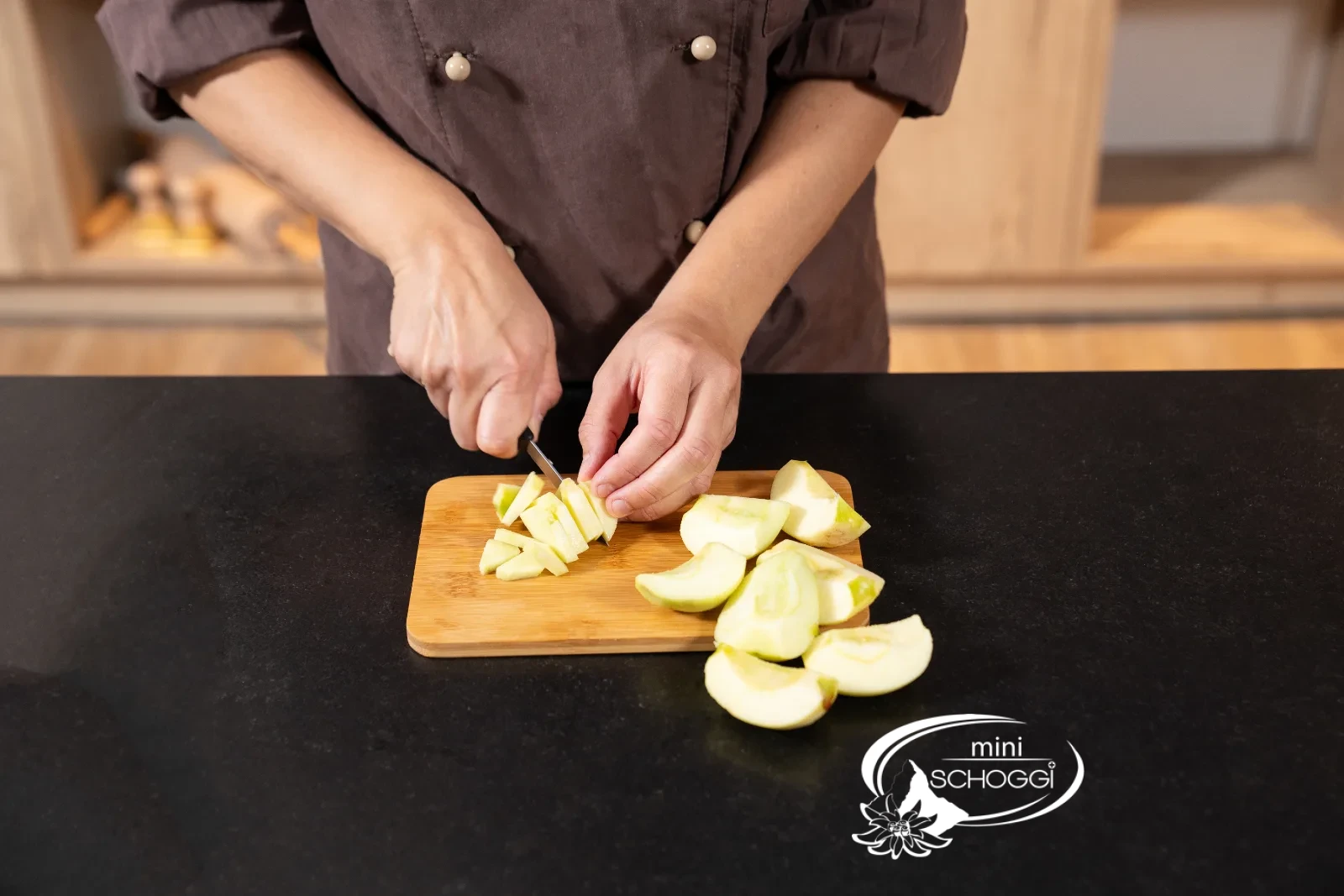
Apple filling
1
Beat butter and sugar, add milk and flour
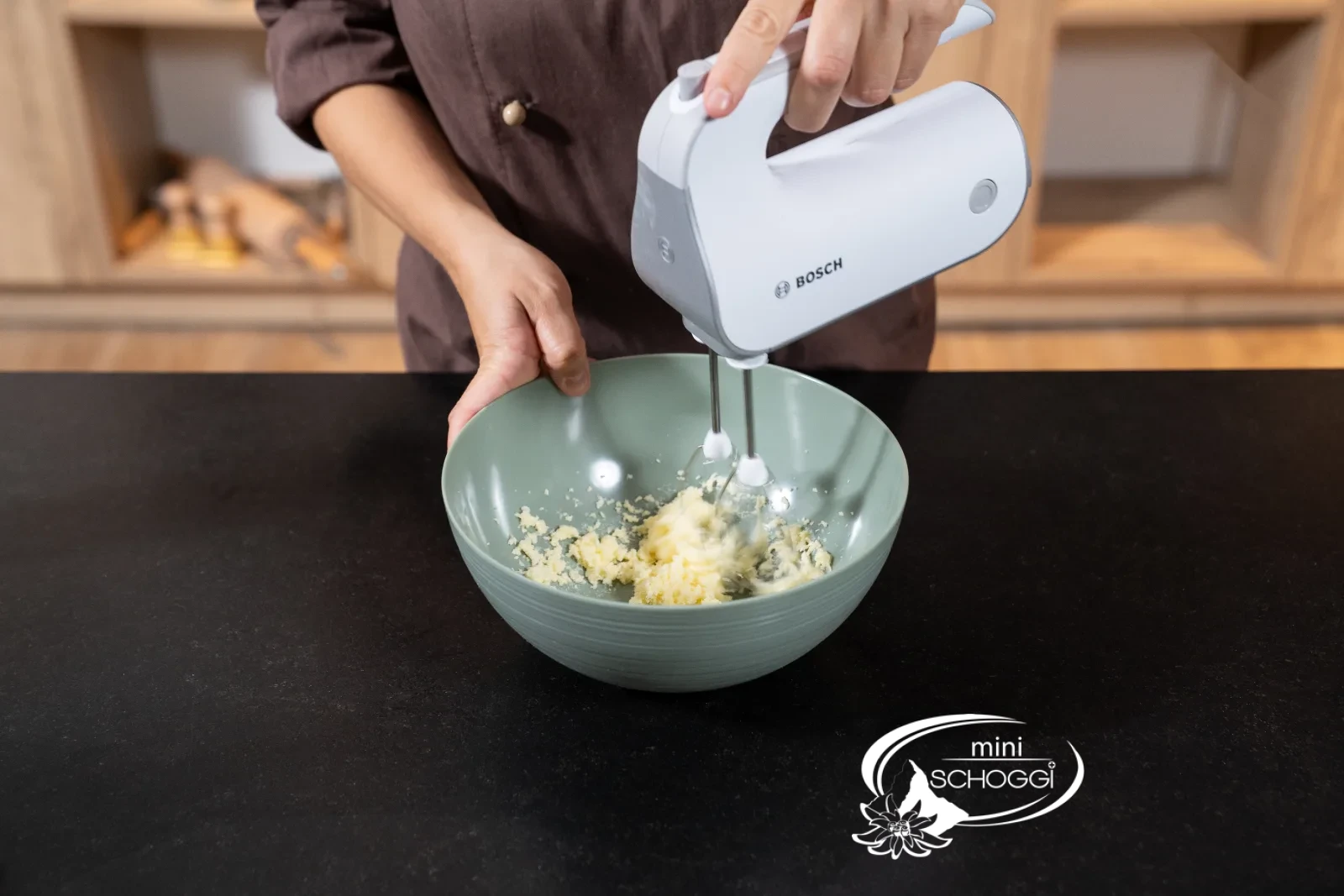
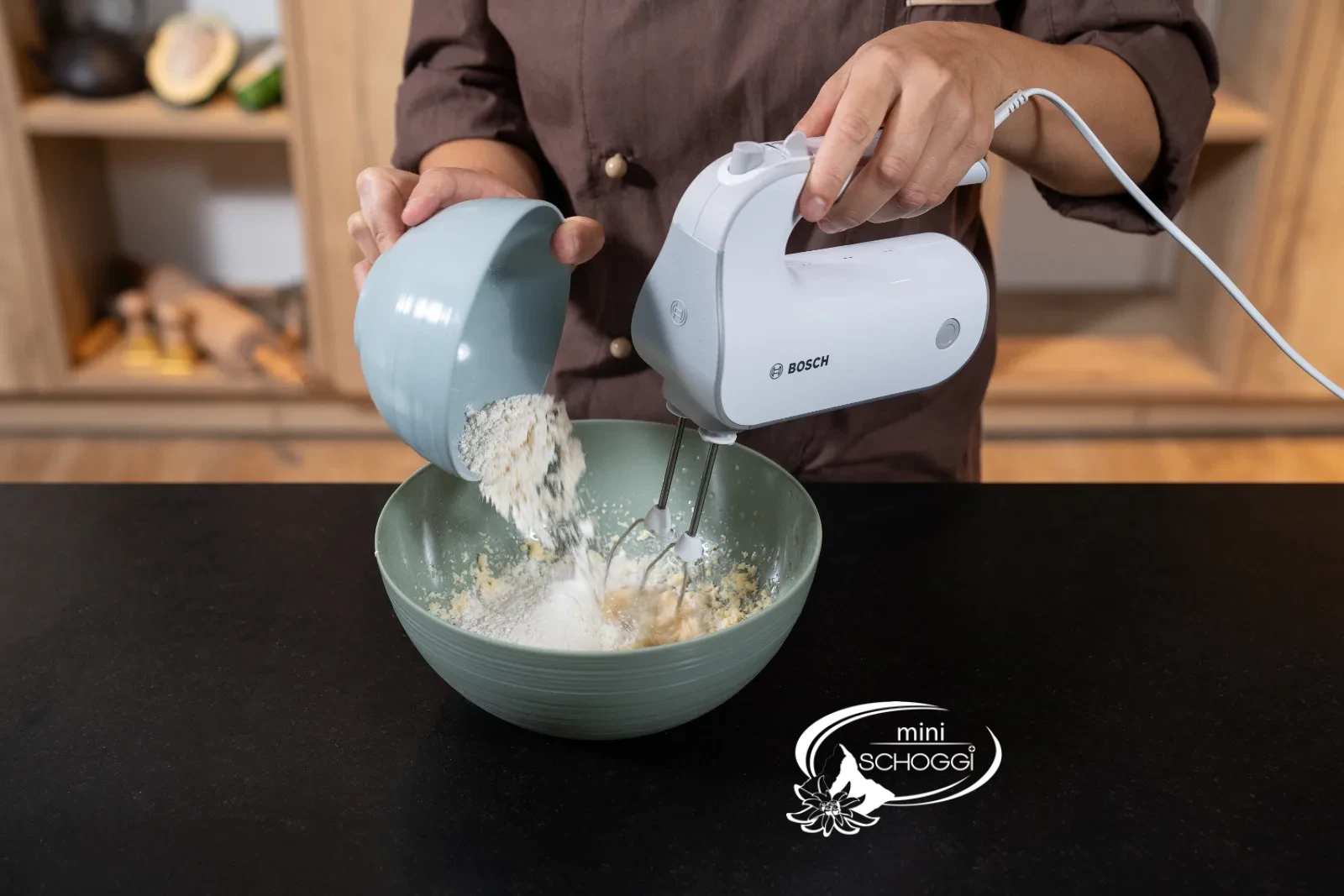
Here too the rule is: room-temperature butter. Beat it with the 20 g of granulated sugar until pale and fluffy, just as with the dough. The rest of the sugar is already with the apples.
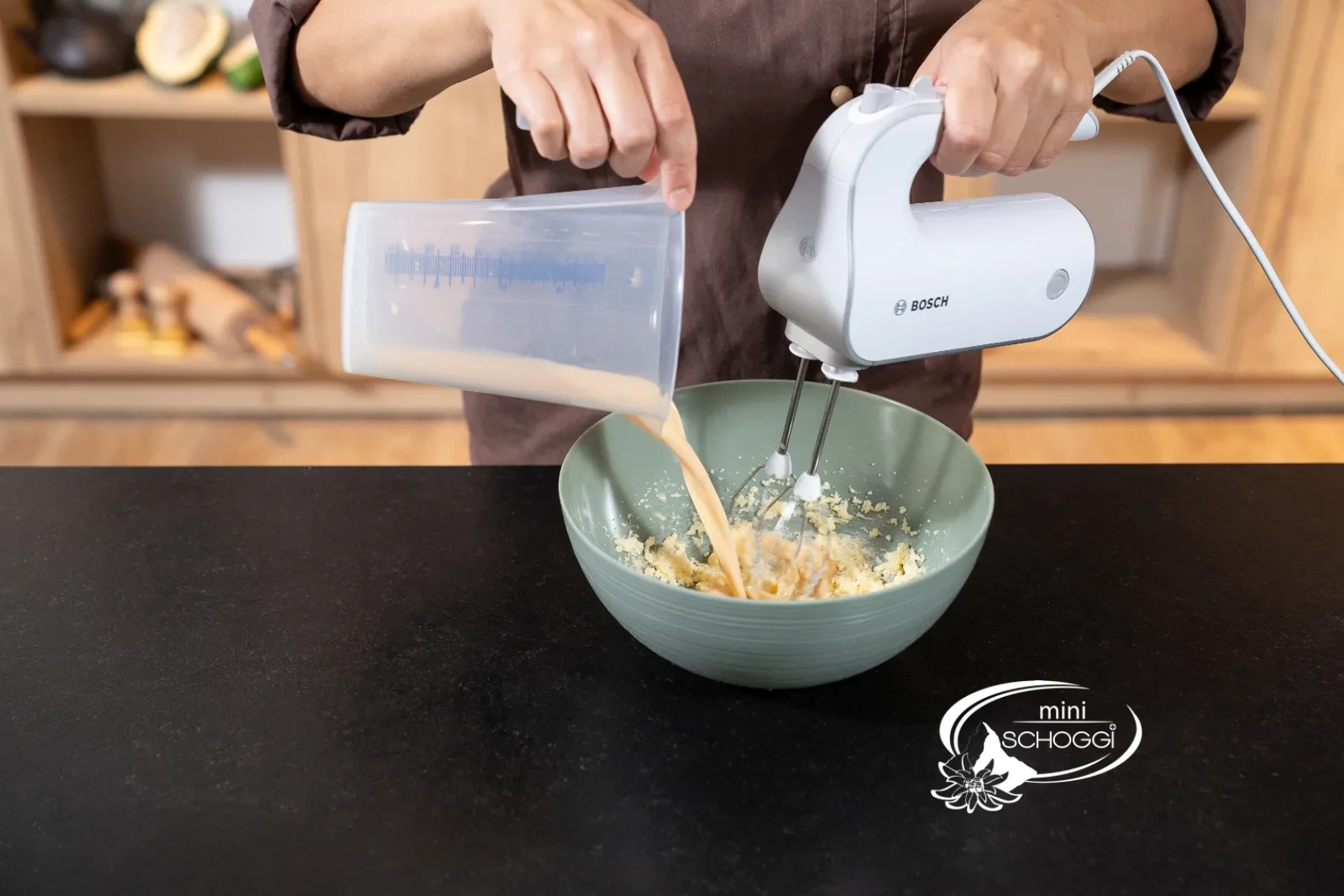
Pour in the whisked whole egg and the milk little by little and stir well each time. In our version there is no yoghurt. All the liquid comes from the 40 g of milk. If the mixture looks slightly curdled at some point, that is no problem: as soon as the flour goes in, it becomes smooth again. Mix the flour dry with the Baking powder beforehand, otherwise pockets of baking powder remain, which end up as bitter spots in the cake.
2
Fold in the apples and fill the base
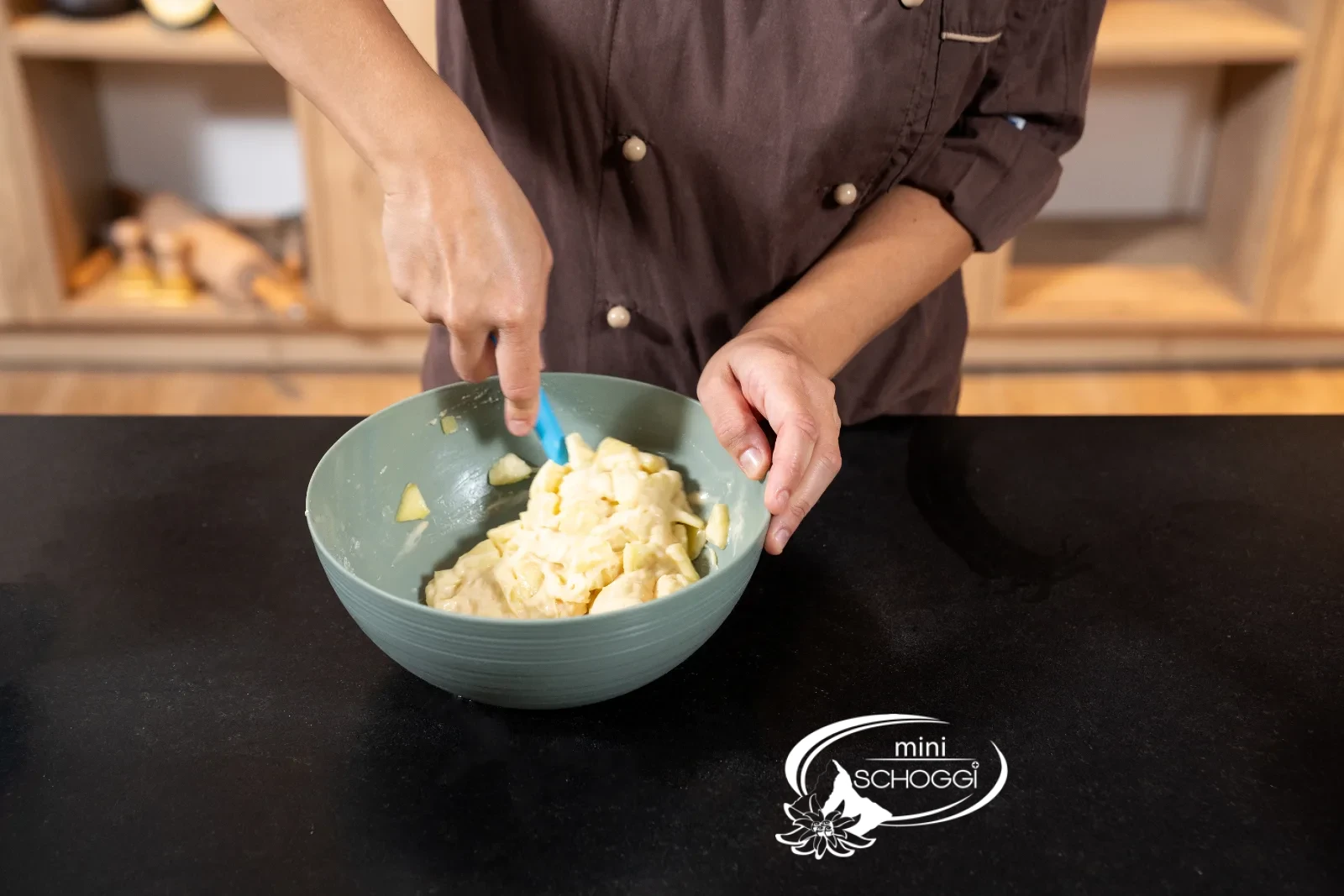
Fold the cooled apples into the mixture with the dough scraper. Fold, do not stir, so the air you beat in earlier stays put.
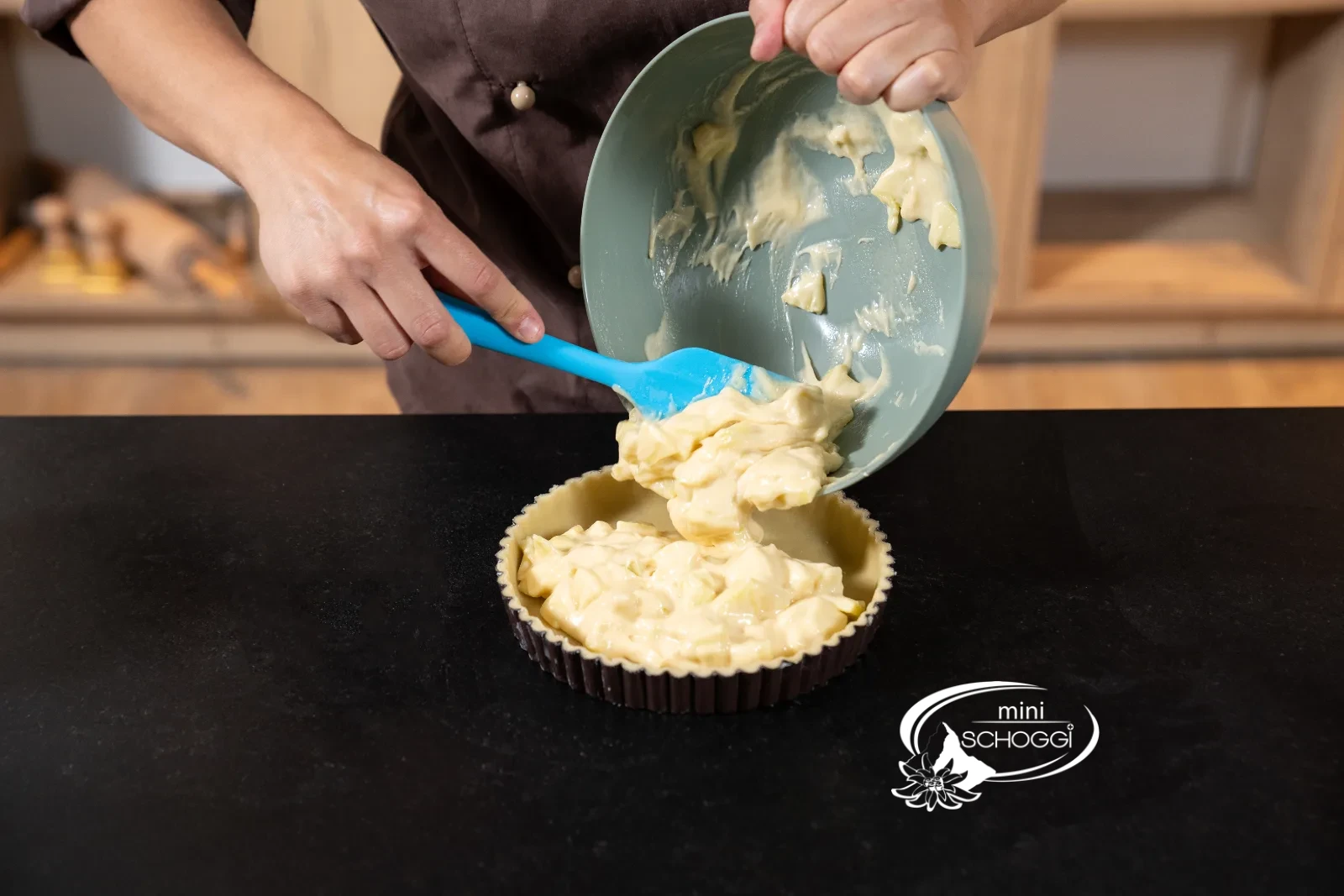
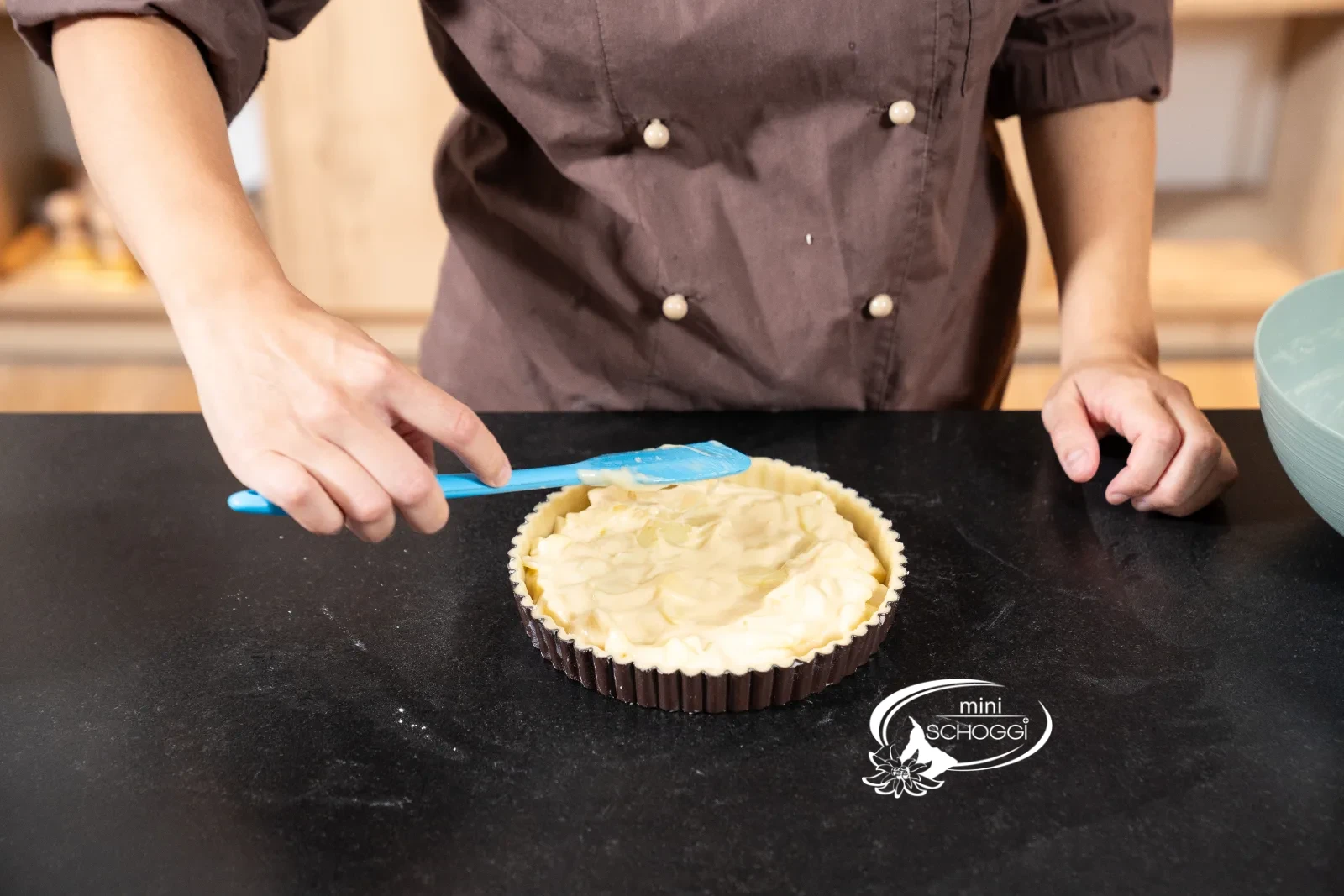
Fill everything into the prepared shortcrust pastry base and smooth the surface with the scraper. Take a moment for this: whatever is uneven in height now will stay that way after baking, and the crunchy topping over it makes every dent visible.
Crunchy topping and baking
1
Cook the caramel to 110 °C and fold in the almonds
Put granulated sugar and Glucose syrup into a medium-sized pan and let both melt over medium heat into a pale caramel. Do not stir with a spoon, but swirl the pan: stirring brings sugar crystals from the edge back into the mixture, and around them the caramel turns grainy. Pale means pale. If it goes dark brown, it tastes bitter.
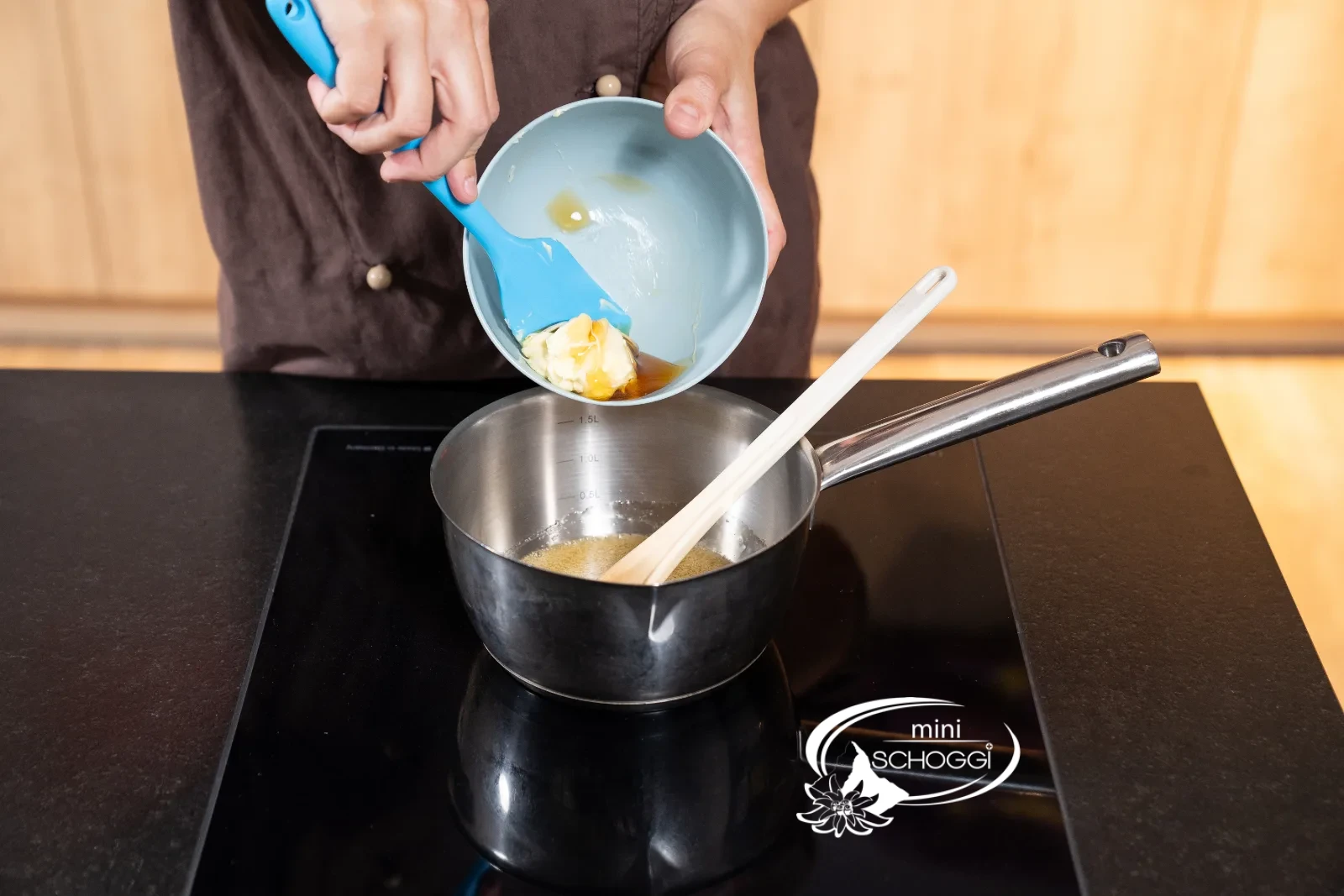
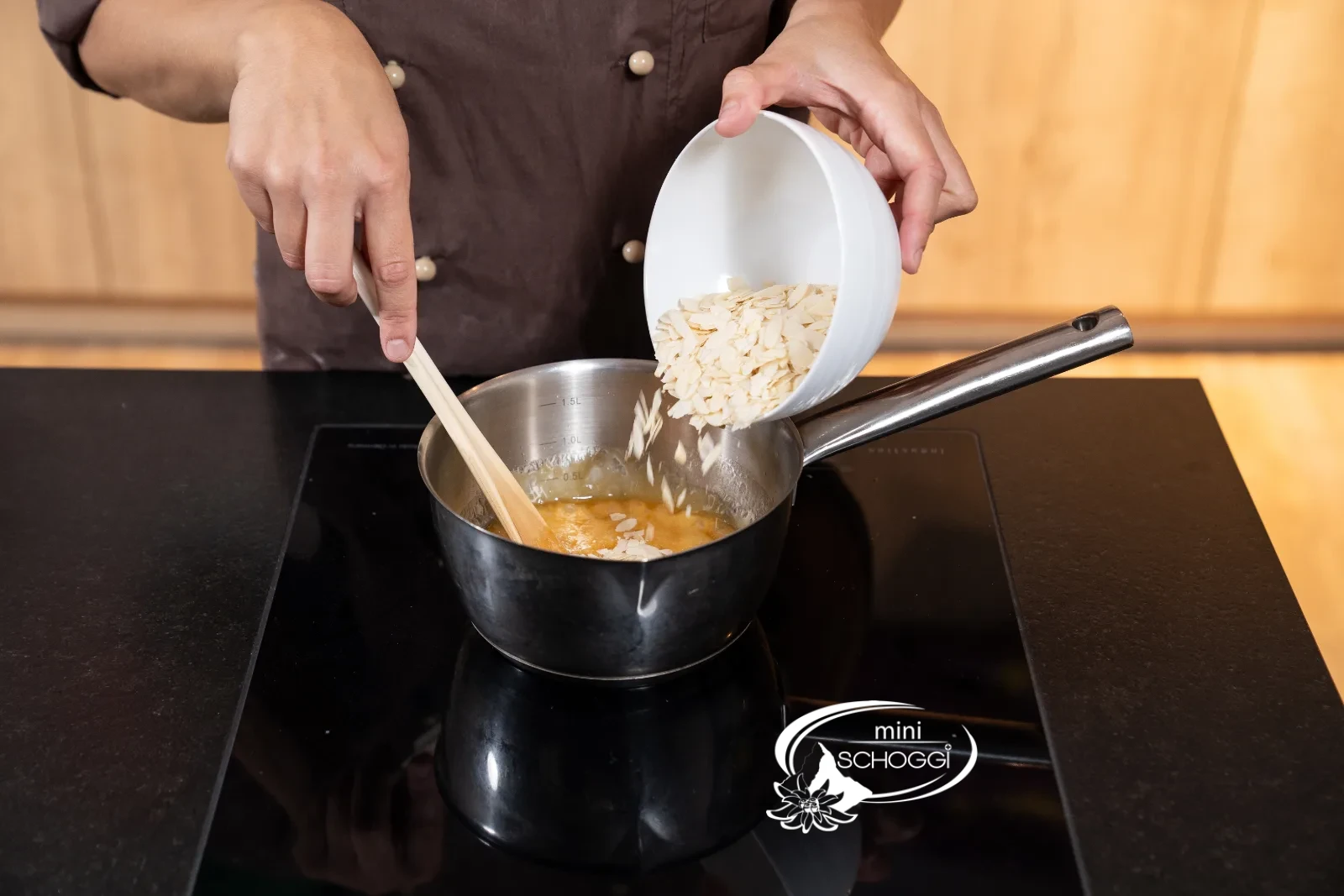
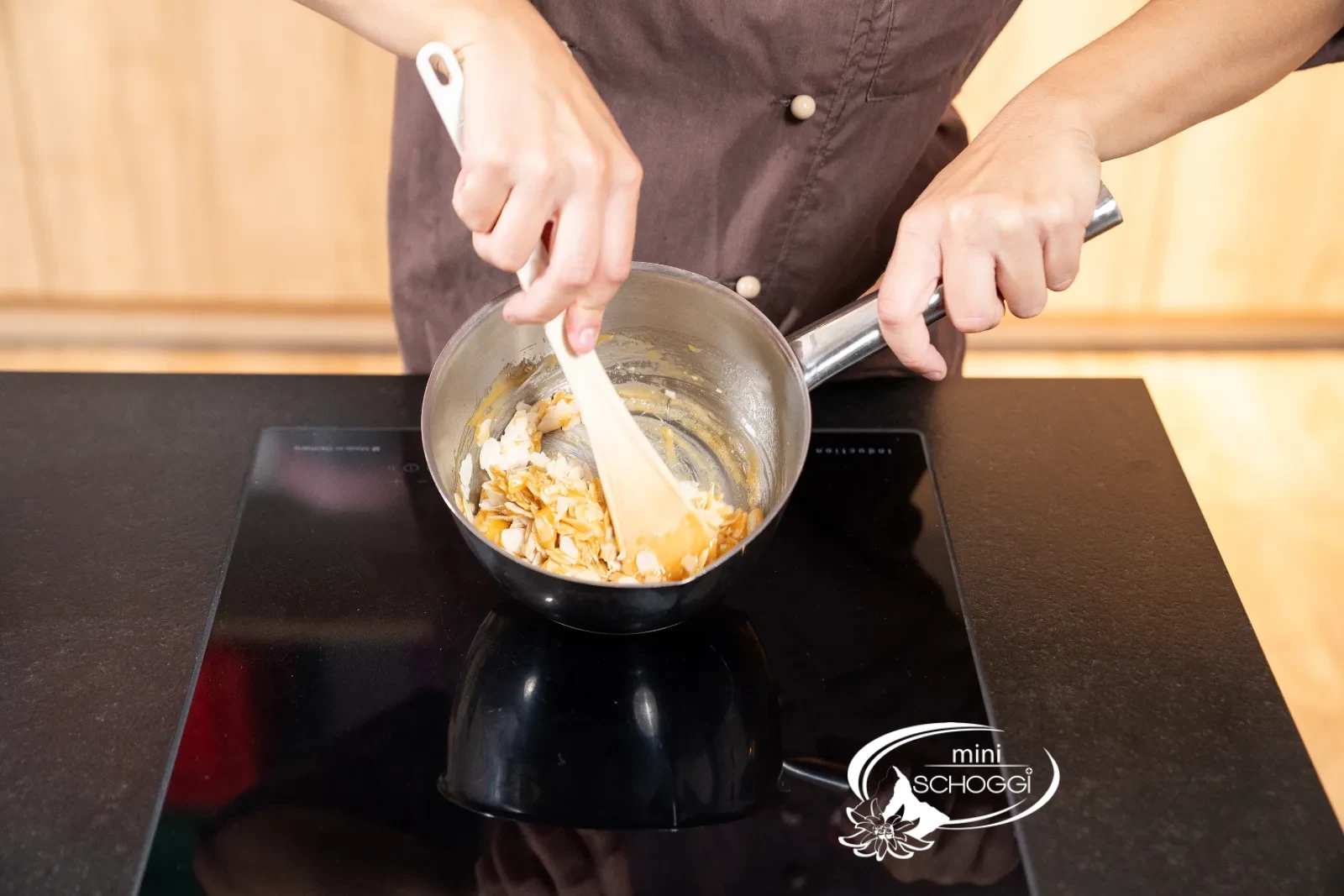
Add honey and butter; it hisses and foams up briefly, that is part of it. Clip in the sugar thermometer and cook the mixture to 110 °C. This number is the real trick of the recipe: below it the topping stays sticky and pulls threads, well above it it turns glass-hard. Finally add the flaked almonds, take the pan off the heat immediately and fold them in until every flake is coated.
2
Spread while hot, bake and finish
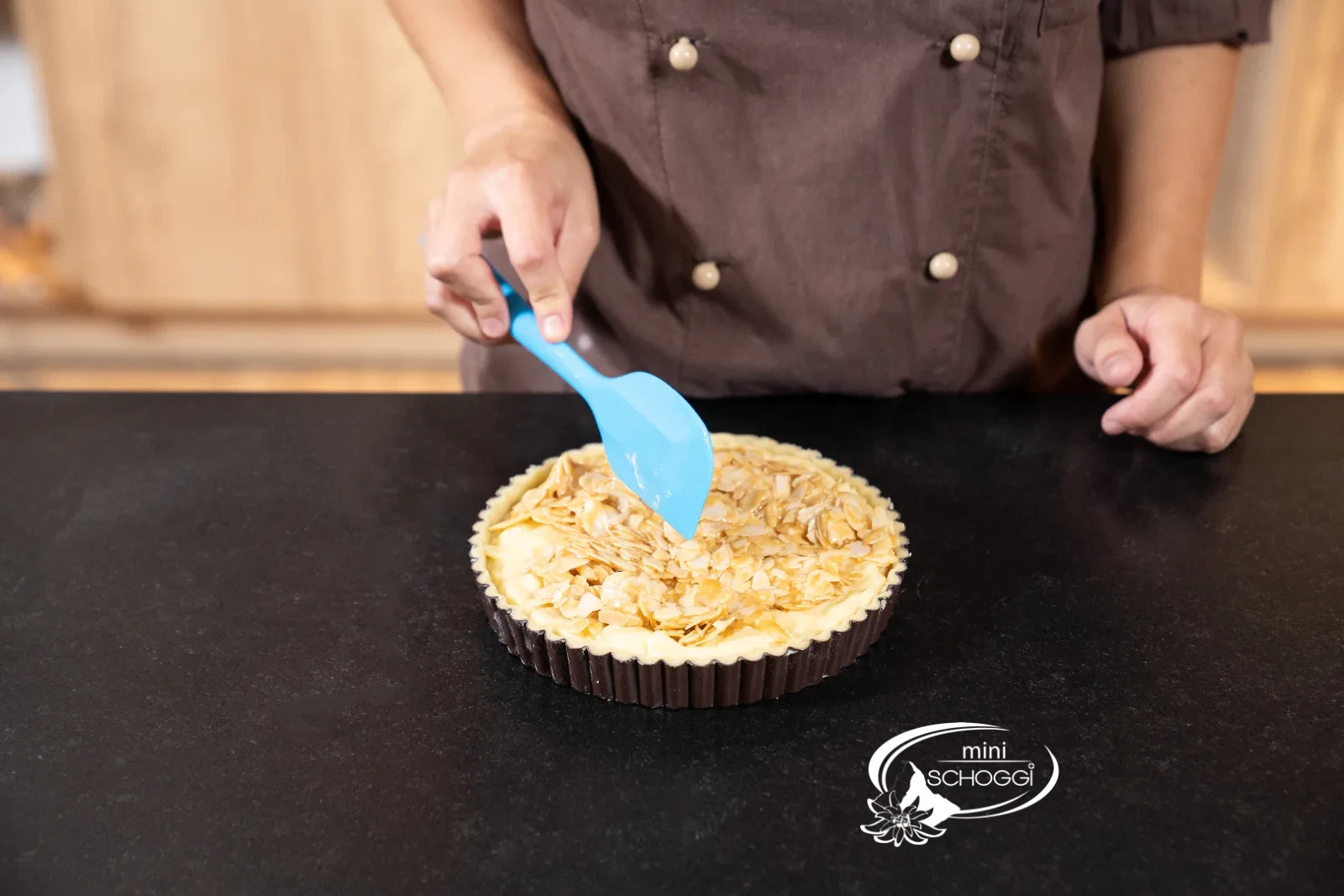
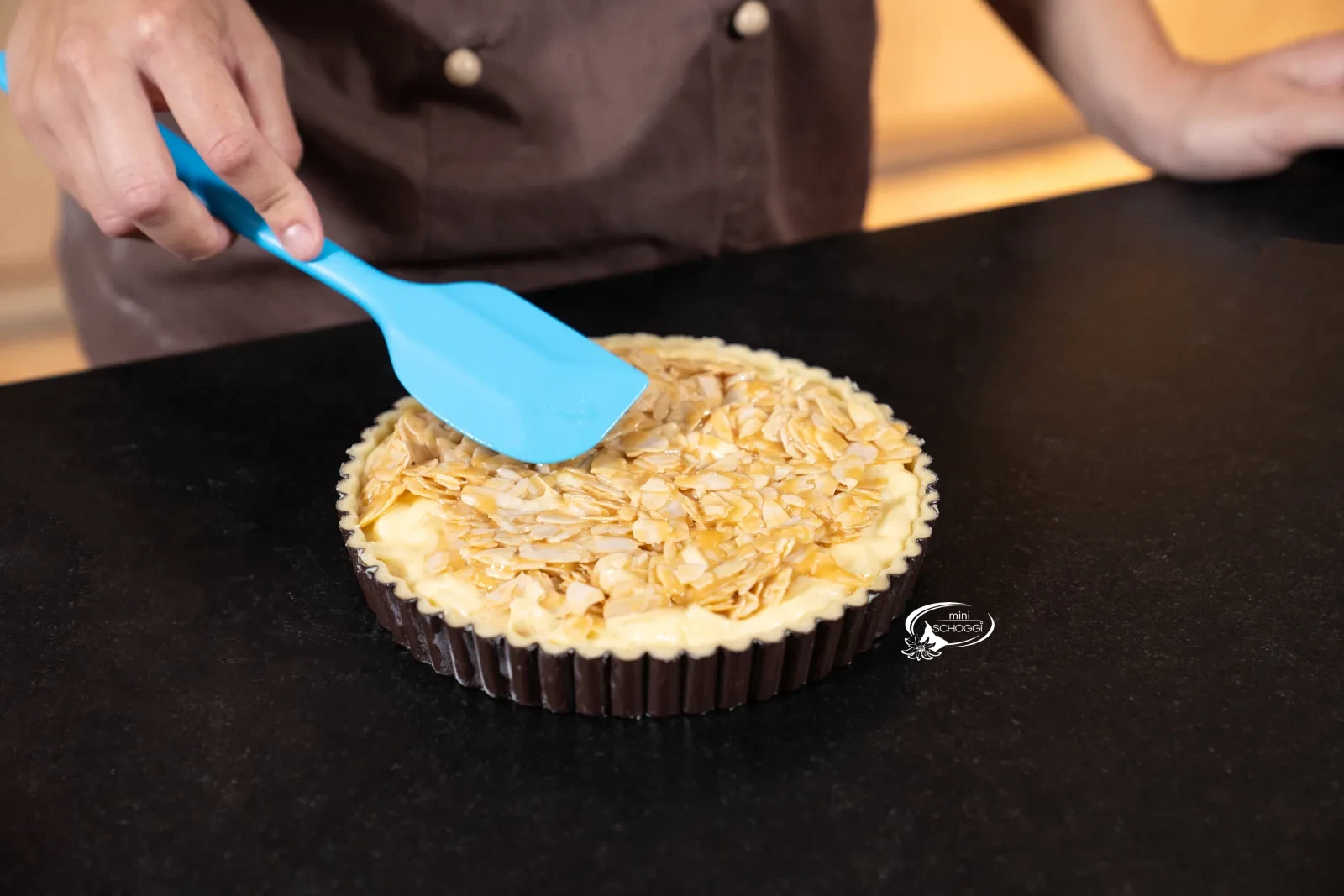
And now work quickly: spread the still-hot crunchy topping evenly over the filling with the scraper. The mixture sets fast as it cools. Once it has set, it can no longer be spread. It does not have to be gap-free, as it flows together a little more during baking.
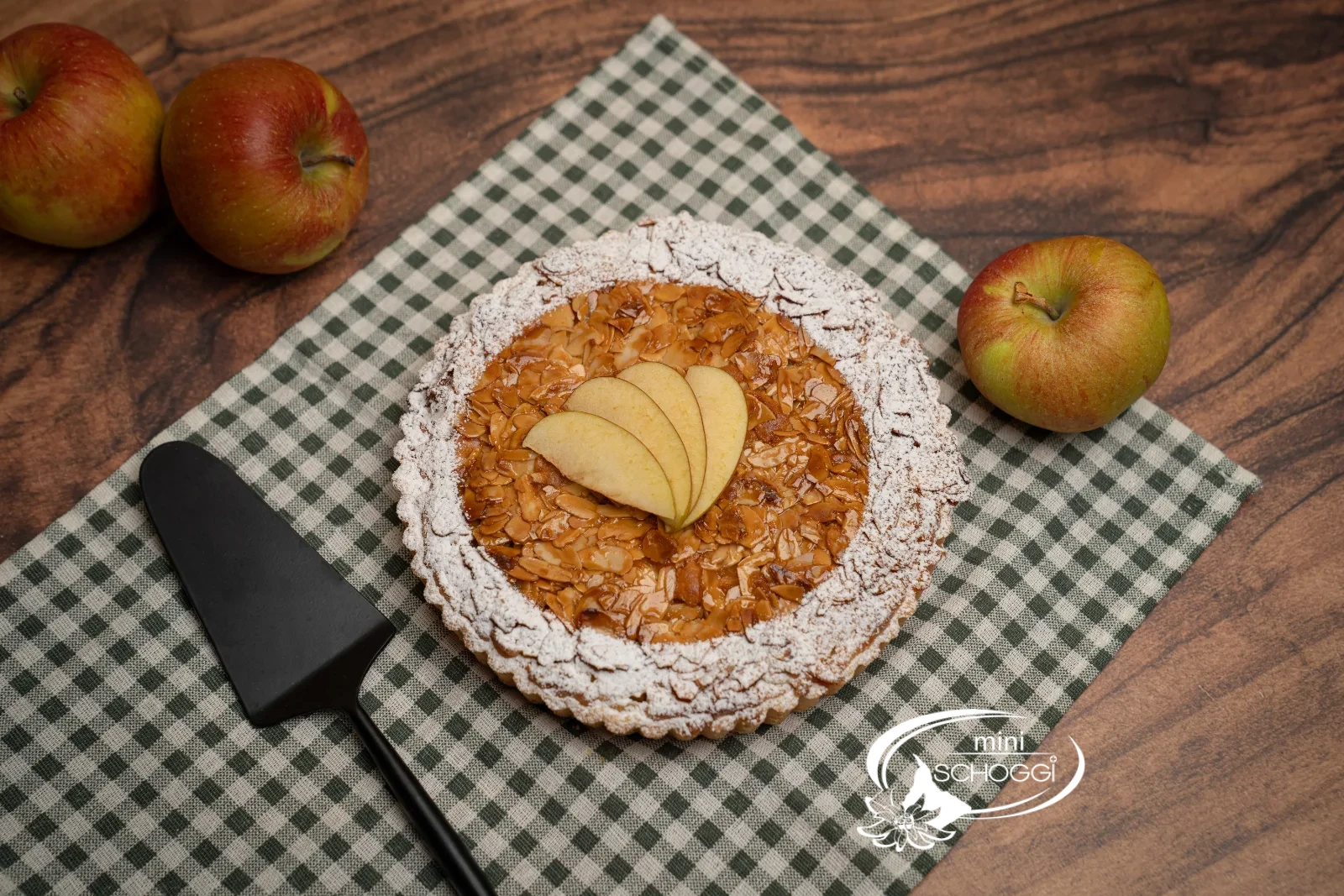
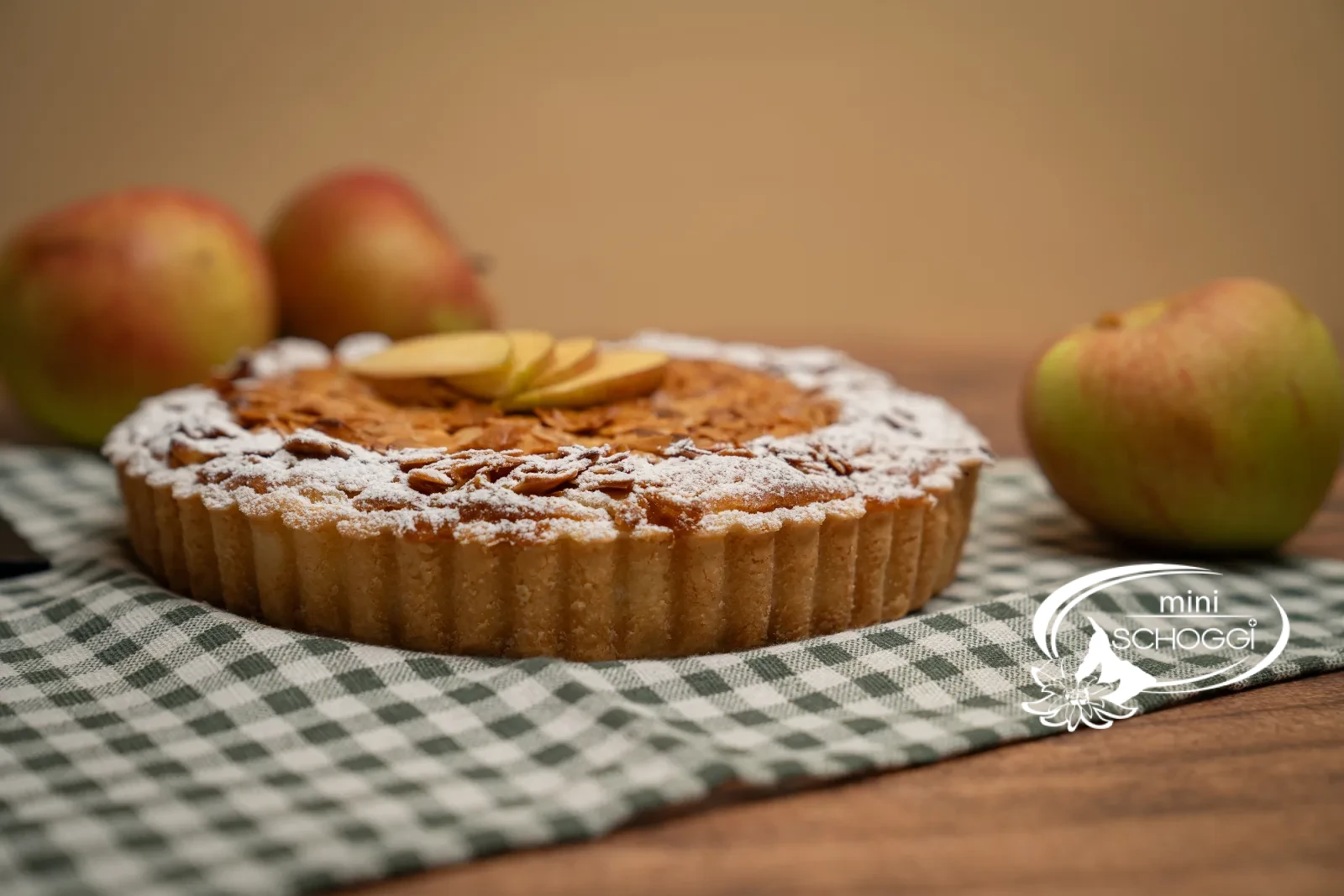
Bake the tart for 20 to 30 minutes at 180 °C fan, until the almond topping is glossy golden brown and the pastry edge is lightly browned. Then place it in the tin on a cake rack and let it cool completely. Do not cut this short: the crunchy topping is still soft when warm and only becomes crunchy as it cools. Release the cooled tart from the tin using the lifting base, dust the edge with icing sugar and decorate it however you like.
Compact · for printing
Apple tart with a crunchy topping
Ingredients
Quantity:
Shortcrust pastry
Apple filling
Crunchy topping
Finishing
Preparation
- Shortcrust pastry: Beat the butter, sugar and salt until fluffy.
- Bind: Add the egg in a thin stream, then briefly mix in the flour.
- Chill: Wrap the dough flat and chill for 1 hr.
- Tin: Grease and flour the tin, roll out the dough 3 bis 4 mm thick.
- Line: Cut out a circle, line the tin, trim off the overhang and place in the fridge.
- Apples: Dice the apples, stew gently with 25 g sugar until slightly soft, let cool to lukewarm.
- Apple filling: Whisk the butter with 20 g sugar, add the egg and milk, stir in the flour with baking powder.
- Fill: Fold in the apples, fill into the base, smooth over.
- Caramel: Melt the sugar and glucose syrup until light, add the honey and butter, cook to 110 °C, fold in the almonds.
- Bake: Spread while hot, bake for 20 bis 30 min. at 180 °C fan, cool, turn out, icing sugar.
Nutritional values per 100 g
432kcal
23.7 gFat
49.4 gCarbohydrates
6.6 gProtein
Storage & shelf life
The apple tart keeps for 5 days at room temperature, covered with cling film or packed in a Cake box. It does not belong in the fridge: there the crunchy topping draws moisture and turns soft.
Everything for this recipe
Recommended from our bakery: exactly the sizes the recipe was tested with.
Ingredients
Glucose syrup, 350g
White flour, 1 kg
FunCakes Baking powder, 80 g
Accessories
Design Tart Baking tin with lifting base, round, Ø 20 cm
Sugar thermometer
Mixing bowl, stainless steel 2000 ml
Professional Dough scraper, 2 pieces
Delivery in 1 bis 2 working days · Free shipping from CHF 100*
A lovely match
Not needed for the recipe, but it fits nicely.
Powdered sugar shaker plastic
Cake box with window white and gold 23 x 23 x 5 cm
Design tart Baking tin with lifting base Design, Ø 25 cm
Design tart Baking tin with lifting base round, Ø 30 cm
Design tart Baking tin heart with lifting base
Design tart Baking tin oval with lifting base, 29 x 20 cm
Design tart Baking tin oval with lifting base, 11.5 x 7.5 cm
Design tart Baking tin round with lifting base, Ø 8 cm
So it turns out perfectly every time
55 g of egg: how to weigh it out correctly
The recipe needs 20 g of whole egg for the dough and 35 g for the filling, 55 g in total. A medium egg without its shell weighs around 50 g, and half an egg cannot be weighed out in any sensible way. So whisk two eggs together in a Mug and weigh both portions from that. The rest becomes scrambled eggs the next morning.
Room-temperature butter is no mere formality
Both mixtures start by beating butter with sugar, and that only works with soft butter. Your finger should be able to press a dent into it without any resistance. If you forgot: cut the butter into cubes and let it stand for 20 minutes. In the microwave it melts at the edges while the centre stays hard, and then it no longer takes in any air.
113 °C means 113 °C
The crisp topping stands or falls with this one number. Below 113 °C it stays sticky and pulls into threads when you cut it; well above that it becomes so hard that the fork slips off. Hang the Sugar thermometer so that the tip sits in the mixture and does not touch the bottom of the pan, otherwise you are measuring the metal and not the sugar.
Frequently Asked Questions
Yes, and it's actually worth it. Wrapped in cling film, it keeps for a week in the fridge and two months in the freezer. Take it out in good time: it needs to roll out without cracking.
Glucose syrup prevents the sugar from crystallising. Without it, the topping turns grainy instead of crystal clear and crisp, and it draws moisture more easily as it cools. In this recipe it can't sensibly be replaced with ordinary sugar.
No. The base, filling and crisp topping bake together for 20 to 30 minutes. All that matters is that the lined tin stays in the fridge until you fill it: cold pastry holds its shape while baking.
Print recipe
Choose what should appear on the printout.
Posted in:
Breakfast, Desserts, Seasonal recipe ideas, Sweet recipes, Cakes and pastries, Sweet pastry
Related products
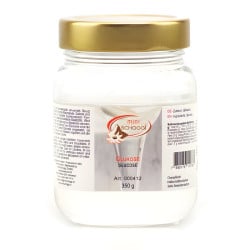
Glucose, 350g
Price: CHF 8.90
Rated out of 5 stars based on
review(s)
favorite
Delete from wishlist
Glucose is a sticky, viscous sugar mixture used in a wide variety of...
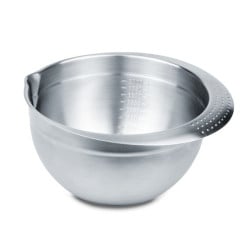
Mixing bowl stainless steel 2000 ml
Price: CHF 31.90
Rated out of 5 stars based on
review(s)
favorite
Delete from wishlist
With this beautiful mixing bowl makes baking and cooking from now on even...
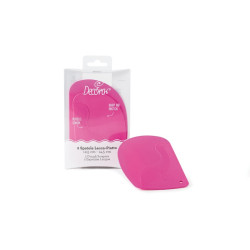
Professional dough scraper, 2 pieces
Price: CHF 5.30
Rated out of 5 stars based on
review(s)
favorite
Delete from wishlist
A dough scraper is perfect for scraping bowls and pans. Get fillings, bread...
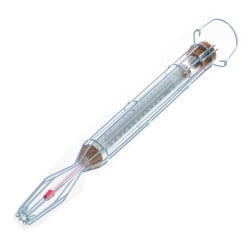
Sugar thermometer
Price: CHF 28.90
Rated out of 5 stars based on
review(s)
favorite
Delete from wishlist
For a perfect caramel or sugar syrup for macarons, buttercream or mousse, a...

Cake box with window White and Gold 23 x 23 x 5 cm
Price: CHF 2.60
Rated out of 5 stars based on
review(s)
favorite
Delete from wishlist
Transport and protect at the same time? This cake box makes it possible! A...
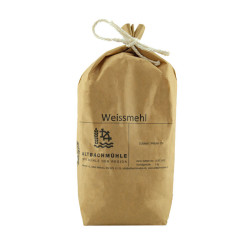
White flour, 1 kg
Price: CHF 4.50
Rated out of 5 stars based on
review(s)
favorite
Delete from wishlist
White flour is suitable for pastries of all kinds, from bread to cakes to...
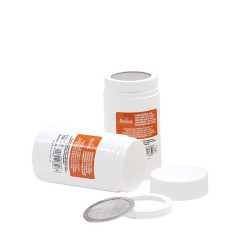
Plastic icing sugar shaker
Price: CHF 12.90
Rated out of 5 stars based on
review(s)
favorite
Delete from wishlist
With this powdered sugar shaker you never have to worry about lumpy...
Design tartes baking dish with lifting base design, Ø 25 cm
Price: CHF 21.40
Rated out of 5 stars based on
review(s)
favorite
Delete from wishlist
Whether classic quiche lorraine, fruity tart, tried-and-tested Linzertorte...
Design tartes baking dish with lifting base, round, Ø 30 cm
Price: CHF 25.60
Rated out of 5 stars based on
review(s)
favorite
Delete from wishlist
Whether classic quiche lorraine, fruity tart, tried-and-tested Linzertorte...
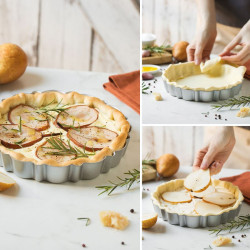
Design tartes baking dish with lifting base, round, Ø 20 cm
Price: CHF 16.70
Rated out of 5 stars based on
review(s)
favorite
Delete from wishlist
Whether classic quiche lorraine, fruity tart, tried-and-tested Linzertorte...
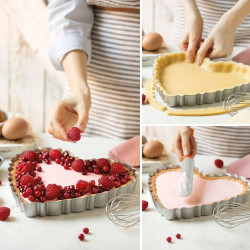
Design tartes baking dish heart with lifting base
Price: CHF 22.50
Rated out of 5 stars based on
review(s)
favorite
Delete from wishlist
Whether classic quiche lorraine, fruity tart, tried-and-tested Linzertorte...
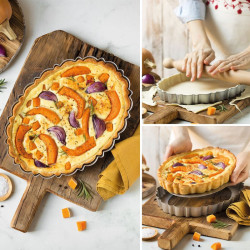
Design tartes baking dish oval with lifting base, 29 x 20 cm
Price: CHF 21.60
Rated out of 5 stars based on
review(s)
favorite
Delete from wishlist
Whether classic quiche lorraine, fruity tart, tried-and-tested Linzertorte...
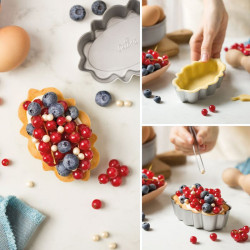
Design tartes baking dish oval with lifting base, 11.5 x 7.5 cm
Price: CHF 7.90
Rated out of 5 stars based on
review(s)
favorite
Delete from wishlist
Whether classic quiche lorraine, fruity tart, tried-and-tested Linzertorte...
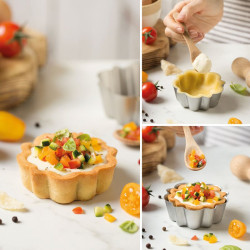
Design tartes baking dish round with lifting base, Ø 8 cm
Price: CHF 7.20
Rated out of 5 stars based on
review(s)
favorite
Delete from wishlist
Whether classic quiche lorraine, fruity tart, tried and tested Linzertorte...
FunCakes baking powder, 80 g
Price: CHF 4.10
Rated out of 5 stars based on
review(s)
favorite
Delete from wishlist
FunCakes Baking Powder is a high quality baking powder that contains the...
Bewertungen
Leave a comment
Related posts
 Make your own chocolate Easter bunnies
You can easily make your own Easter bunnies at home! You can find out how to do it and what you need here. A sweet...
Read more
Make your own decorative Swiss roll
Make your own decor roulade - we'll explain exactly how in this blog, with lots of tips and tricks from our...
Read more
Cinnamon stars with almonds and egg white icing
Moist cinnamon stars made from almonds, sugar and cinnamon with snow-white egg white icing. No flour, with the icing...
Read more
Make your own chocolate pumpkin pralines
Make your own 3D chocolate pumpkin pralines - here you get detailed instructions with lots of tips and tricks...
Read more
How can I convert a cake recipe?
Converting a cake recipe, whether a sponge or a cake filling, is easy with our conversion table.
Read more